Showing posts with label Empress of Ireland. Show all posts

Thursday, 12 June 2014

Empress of Ireland: Survivors Experiences

THE CANADIAN DISASTER.

ARRIVAL OF SURVIVORS.

SCENES AT GLASGOW.

Desperate Fights for Life

Glasgow, Tuesday. -- The Allan liner Corsican berthed in the Princes Dock, Glasgow, at four o'clock this morning, bringing the surviving members of the crew of the ill-fated Empress of Ireland, and also a number of her passengers. Arrangements had been made for boarding the ship off Greenock at eleven o'clock last night, but an official intimation that she was likely to appear off the Tail of the Bank at least two hours earlier caused many persons, including a strong force of newspaper representatives, to hasten down to Greenock. They were grievously disappointed, as it was half an hour after midnight before the Corsican hove in sight, and there was a scramble to board her from a tug. Her captain feared to lose the tide, and so the steamer merely slowed down for an instant, and then passed on to her destination.


The passengers most sought after were in bed, and the sailors who had been saved from the Empress of Ireland were not to be approached until after berthing, but between midnight and 4 a.m. the representatives of the Board of Trade had appealed, and after the Corsican had cast off her tugs inquisitive persons were informed that an official inquiry was proceeding. A rumour had spread at Greenock that the survivors amongst the seamen were to be represented by one of their number, who would make a statement for publication, but it transpired on the authority of an official that no such arrangement had been contemplated. A pledge was also exacted that no attempt should be made to approach the passengers until a certain time had elapsed.

A PATHETIC INCIDENT. 

One pathetic incident marked the arrival of the Corsican. A Mr. Newton, of Southport, travelled to Greenock with a sister-in-law, who had a brother, Mr. J. W. Furness, first violinist on the wrecked vessel. This lady, Miss Furness, went alongside on the tug, but was not permitted to board the Corsican. In the list of saved there had appeared the name of Furness, but with different initials from those of her brother, and the relatives had journeyed down from Lancashire in the hope that the initials had been wrongly printed, and that the musician was aboard the Allan liner now nearing port. Miss Furness remained on the deck of the tug until it had piloted the Corsican into dock, and Mr. Newton signalled from the steamer that their hopes WW* but ill-founded. Miss Furness, realising the worst had happened, became prostrate with grief, and received many expressions of sympathy.

Mr. Furness was formerly a ship's bandmaster, but coming home from a trip and finding his aged mother at the point of death he elected not to sail on the outward voyage. His ship left the United Kingdom without him, and his agents then offered him the position of first violinist on the Empress of Ireland. This he accepted. His father, now old and infirm, was in an agony of suspense awaiting the news which his daughter and son-in-law had to take him from Glasgow as to the result of their quest.

There was a scene of greet activity on board the Corsican after she had docked, and much of this was due to the distribution by Allan line officials of a complete kit to the rescued seamen and passengers, the latter of whom were all third-class.

AN AUSTRIAN'S NARRATIVE.

Mr. A. Heller, a passenger of Austrian Extraction, but a naturalised American citizen, recently living in Toronto, in the course of a conversation aboard the Corsican, stated that he was in the habit of making monthly journeys to this country. "I was," he said, "in the steerage of the Empress of Ireland, and there were three others occupying the same cabin. I was sleeping at the moment of the collision with the Storstad, and was awaked by one of my three companions. We all immediately left the cabin to get up the companion-way to the deck, but so great was the list in the ship at that time, and so unsteady was her movement, that I slipped back three times. I was wearing a shirt and pants only. Eventually, and with some difficulty, I managed to get to the deck when the ship was heeling over, and it was next to impossible for me to keep my feet. I went towards the lifeboats, but there was scarcely time to swing them free of the davits owing to the rapidity with which the ship was settling down. The man who awoke me was, I regret to say, among the drowned. There were a good many people out of their berths, including women and children.

"I slid down pretty nearly to the water's edge and then dived. I am a good swimmer, and I was anxious to get away from the ship, as one of her funnels was apparently hanging over. At the instant of my throwing myself into the water women were screaming and clinging to all sorts of floating gear. Some passengers were rolling into the sea, as the decks were getting well-nigh perpendicular. I had just got clear when the Empress of Ireland disappeared. Everything then became quiet. It was after I had been keeping afloat for twenty-five minutes that I was picked up by a boat. There were twenty-six members of the crew in that boat, and there was room for eight or ten more occupants."

THE SURVIVORS.

The British survivors are --

Mr. S. C. Furness and Mr. G. Dransfield (Liverpool).
Mr. W. G. Bevan (Swansea).
Mr. C. Bristow and Mr. C. H. Bristow (Leeds).
Mr. Martin Gill (Belfast).
Mr. G. C. Kirtley (West Hartlepool).

With the exception of Mrs. Kirkley, all the Britishers declined to make statements. Mrs. Kirkley told a short but graphic story of how she escaped. The lady was in charge of a nurse on the Corsican, but she had sufficiently recovered from her terrible shock to be able to relate her thrilling experience. Mrs. Kirkley is a good swimmer, and to that she owes the fact of the almost miraculous circumstance of being alive to-day.

LADY'S FIGHT FOR LIFE.

She stated -- "As soon as I realised the danger I ran from my cabin to the deck. It was a matter of no little difficulty, too, as the ship almost immediately lurching upon its side, I could not get at a boat, and saw the only chance was to dive and trust to my swimming capacity and luck. When the rail of the ship was near the water's edge I dived, and went no considerable distance under. Striking upwards I got to the surface, when I saw several people around me floundering about and moaning and shrieking. Then a man who was in almost a state of collapse caught hold of me when I was approaching a boat. I was by this time fast becoming exhausted, especially as the man clung to me like grim death, and try as I would I could not get him to release his grip.

"With a supreme effort I managed to clutch the boat after having been in the water a few minutes; then I threw one of my legs over the side of the boat rail, but the man still clung to me. To save myself, for it was my only possible chance, I shook the man off. With a cry he sank, and that was the last I saw of him. I could do no other. My strength was fast going, and had I not acted as I did I should have dropped back into the sea and been lost." Mrs. Kirtley is a lady of about thirty-five and of fairly robust build.

The arrival of the Corsican was expected, and even at that early hour many people assembled outside the shed of the dock where she was berthed in the hope of getting a glimpse of the survivors. The sailors on the river cheered.

The stewardess of the Empress told how, when she heard the crash, she made for the upturned side of the ship, slipped down the deck, and dived just as the vessel was about to sink. "I can only remember," she added, "someone catching hold of me, and I woke up safe on board the Storstad.

Soon after reaching Glasgow the Continental survivors entrained for Grimsby en route to Hamburg, the Empress passengers for their respective destinations, and the majority of the crew for Liverpool.

-- -- -- -- -- -- -- -- -- -- -- -- --

SURVIVORS AT LIVERPOOL


REJOICING AND SORROW!

The Allan liner Alsatian arrived at Liverpool yesterday with a large number of survivors from the Empress of Ireland. Among them were six first-class passengers, six second-class, and thirty-five steerage, the latter nearly all foreigners. There were also on board 106 stewards, fifteen deck hands, and five members of the engine-room staff of the ill-fated liner.

The Alsatian also brought home nine bodies of victims -- namely, Chief Officer Steede, Storekeeper Wildman, Miss Biddlel, stewardess, and six foreigners.

A large number of relatives and friends of the members of the crew proceeded down the Mersey on a tender to meet the liner. There were loud cheers as the survivors were recognised, and when they landed there were many affecting scenes.

DRAMATIC SCENES.

The survivors aboard the Alsatian presented a curious spectacle, and some of their relatives experienced difficulty in recognising them. They were attired in all kinds of suits, and many of then seemed to have had complete new rig-outs. When the survivors met their relatives in the waiting-room at the landing stage the joy of reunion in many cases was almost hysterical. The woman flung themselves sobbing into their husband's arms, and the children cried with delight as they held their fathers by the hand.

One pale-faced woman was almost smothered with kisses by her husband. She had given birth to a baby boy fourteen days before the disaster. At first her husband was reported drowned, and the woman had almost given up life and hope when she received a cablegram announcing that he was saved.

CLIMB THROUGH PORTHOLE.

Tipperary Man's Narrative

Mr J. D. Langley, of Tipperary, a second class passenger aboard the Empress of Ireland, told a graphic story on landing. He said that on reaching the doors to that deck he found they were closed. Some people who were trying to get out declared they were jammed. He volunteered to try and clamber through a port hole to open the door, but stuck when half-way through. He, however, managed to wriggle through, and tried to open the door. It would not budge, and he told the people inside he must leave them. He scrambled on the railings where there was a member of the crew with a life belt on.

When the ship sank they went down with her, but came up to the surface within a few feet of each other. They kept afloat about ten minutes witnessing embarrassing scenes, but eventually came alongside an upturned lifeboat. They were pulled on that by some of those already aboard, and sat shivering there for two hours before rescued by a pilot boat.

Between them they pulled fifteen or twenty people out of the water, and watched two men with lifebelts on drown, being unable to reach them. It was hideous hearing people who were drowning call for help. He saw no women in the water, and concluded that they had been unable to leave the ship.

"WHERE'S MUVVER."

Mr. J. J. Lennon, of Winnipeg, said he saw a little girl in night attire lying unconscious in the water. He managed to pull her into a collapsible boat. She soon came to her senses, and asked "Where's Muvver." He told the child her mother would be all right to comfort her, and they took bar to Rimouski.

OTHER STORIES OF ESCAPE

Percy Gee, a steward, said he just managed to scramble out of the boat which had rescued him when one of the lifeboats fell on it, killing and injuring several people, and smashing the boat to pieces. He was picked up by a collapsible boat after being in the water about half an hour.

Robert Crellin, of Cleator, who rescued Florrie Barber, a little girl, whose mother and sister were lost, said he fetched her from the cabin, and when the ship was sinking plunged into the water with her. He swam toward a lifeboat through bitterly cold water, which was crowded with dead and dying people. They were taken into a boat which contained over sixty people. The most terrible part of the disaster was the sight of hundreds of people struggling in the water while the boats near them were too full to take any more aboard. The water was black with heads bobbing up and down, and the cries were pitiful. He had left the child at Quebec, where there were several wealthy people desirous of adopting children who lost their parents in the disaster.

Mrs. Fanny Evinson, of Leeds, who lost her husband and baby, said in the companion way the people were fighting for their lives; bit the foreigners were the worst, as they tried to force their way on deck carrying luggage. They were all blown into the water by the explosion or rush of air, and on coming to the surface she could see nothing but the heads of people crying for mercy. She managed to keep herself afloat, although unable to swim, until she clutched the sides of the boat. Next day she learned that her husband and baby were drowned.

-- -- -- -- -- -- -- -- -- -- -- -- --

BELFAST SURVIVOR'S EXPERIENCES.


A THRILLING STORY.

Mr. Martin Gill, a Belfast man, who is one of the survivors of the Empress of Ireland disaster, has arrived in Ireland from Glasgow, to where he travelled from Canada by the Allan liner Corsican. In the course of an interview he said that as the ill-fated liner dropped down the river he retired to his cabin, and in a short time was asleep. The next moment of consciousness came to him as the collision took place. "I awoke," he said, "at the sound of a mighty crash which was followed immediately by an indescribable sound of grinding and smashing. For m moment I was half-stunned with the noise and the concussion, but soon realised that some catastrophe had befallen the ship. I suppose the memory of the Titanic's fate suggested a collision with an iceberg, but that was the first thought that sprang to his mind. Two minutes later I was in the midst of some people scrambling for the deck. I didn't dress; in fact all the passengers I saw were in their night-clothes. The awful sound of water rushing into the ship was enough to upset the coolest of us, and I, for one, did not take time to lift anything. I had 1,500 dollars, and all my worldly possessions in the cabin, but when life depends on moving quickly, one does not think of such things. On deck I saw that another steamer had collided with the Empress. The bows of the Storstad had bitten 8ft. into the side of ship.

"I didn't wait much longer. Torrents of human beings were streaming out to the decks, and darkness added to the confusion. From the top deck of the ship I dived into the icy water, and, after what seemed an interminable period, I came again to the surface and struck out. I never considered myself a good swimmer, but I found I could swim well when I had to save my life. I swam directly away from the Empress towards the Storstad. There was a fog on the water at the time of the collision, but it suddenly lifted like a veil and I could see both vessels. I had got a hundred yards from the Empress when she foundered. I will never forget the sight as long as I live, and the moans, shrieks, and shouts are still ringing in my ears.

"I was in the water about half an hour, and had almost reached the Storstad," continued Mr. Gill, "when I was picked up by one of her lifeboats. I didn't know a single person on board, although most of the survivors have lost relatives who were traveling with them." Mr. Gill, who was supplied with clothes and passage money by the C.P.R., was asked if he were going back to Canada. "I had intended to go back," he said, "but I have not yet got over the shock of that awful night, and I may decide to remain in Ireland for the future."


This article originally appeared in The Witness 12 June 1914.

image top: Emigrants on the Empress of Ireland

Monday, 9 June 2014

Empress of Ireland - Official Inquiry and Storstad's Defence

CANADIAN CATASTROPHE.

TOLL OF THE DEAD.

WORLD-WIDE SYMPATHY.


THE OFFICIAL INQUIRY.

It is expected that the Court of Inquiry appointed by the Canadian Government to investigate the loss of the Empress of Ireland will be composed of Sir Adolph Routhier, the Hon. Ezekiel M'Leod, and Lord Mersey, the latter being the nominee of the British Board of Trade. The third class survivors have been transferred to the Allan liner Corsican, which is due in Glasgow on Tuesday of next week.

Quebec, Wednesday. -- The Canadian Pacific Railway yesterday evening issued official figures raising the number of fatalities in the Empress of Ireland disaster to 1,024, or fifty-five over the previous figures. The vessel carried 1,476 persons, of whom 452 were saved -- namely, thirty-six first cabin, forty-seven second cabin, and 136 steerage passengers, and 233 officers and crew. Only a few more than 200 bodies have been recovered, of whom 103 have been identified.

IDENTIFICATION PRECAUTIONS

The European manager of the Canadian Pacific Railway in London has received an official cable to the effect that the entire Delamont family of five, belonging to Toronto, who were third class passengers, were saved. The only further identification of the bodies advised has been that of May M. White. In order to assist in the proper identification by relatives at a future period precaution is being taken to have the bodies photographed, each with an indication number, which will also be used for the grave.

THE STORSTAD'S DEFENCE

Amazing Statements.

Montreal, Monday. -- The following statement is made by Mr. J. W. Griffin, of New York, representing the owners of the Storstad --

Conversations with several officers and members of the crew of the Storstad all bear out the story that the Storstad was going full speed astern when the collision occurred. One of the most important statements made was by the third engineer of the Storstad, who refused to give his name. He said that he was on duty in the engine-room when the collision took place. He was asked, "How long before you struck was the signal given to go astern?" He replied, "It is impossible to say definitely, but it was something like a minute; I should say a little longer than a minute."

"There is no doubt about your having got the signal to go full speed astern?" "I am certain the engines were going full speed astern when the collision took place."

The third engineer's statement was borne out by the second engineer, who was not on duty at the time of the accident. He asserted that at no time for several hours before the collision had the Storstad gone at greater speed than ten miles an hour. Thick fog was encountered at intervals. The shock of the impact was not very noticeable. I did notice, however," he said, "that the engines had been reversed. We were going full speed astern about one minute before the shock."

When asked regarding the evidence given at the inquest that had the Storstad not backed away the Empress of Ireland might have been kept afloat long enough to allow most of the lifeboats to be lowered, the second engineer stated that he did not think that would have been the case. The blow struck was a glancing one, and even had the Storstad gone ahead instead of astern she would have glanced off, and both steamers would have been separated just as quickly as they were in fact.

A ZIG-ZAG COURSE.

Captain Holtung, of the Norwegian collier Alden, has told a highly-responsible official what his second officer and pilot saw when they passed the Empress of Ireland some thirty sea miles from where the collision occurred only a short time before the disaster. According to what the official told the "Montreal Star" this is what took place --

The Alden, chartered by the Dominion Coal Company, was on her way up the St. Lawrence, only thirty miles from Father Point, when the Empress of Ireland was sighted steaming towards them. Both the pilot and second officer were on duty on the bridge of the Alden, and are said to be willing to swear to the following --

The Empress of Ireland was steaming down the St. Lawrence when they met her. She was approaching the collier in such an erratic manner that both pilot and second officer became greatly concerned. So erratic, they are said to have declared, was the course that at times her green light could be seen, at other times her red lantern would show. The course of the Empress of Ireland is described as zig-zag.

Another officer of the Storstad said he was awakened in his bunk by the clanging of the bells in the engine-room. Hastily going on deck, he noticed the ship going astern. Almost immediately came the collision. Quickly he helped to lower a boat and started to pick up passengers. There was no trouble in getting a load full. Altogether sixty were saved in the first trip, So heavily was the boat loaded that she all but sank on her return to the Storstad. As far as this officer could tell, four other lifeboats were lowered from the Storstad. Most of those saved in the first trips belonged to the crew of the Empress of Ireland. He could not account for this beyond supposing that they were better able to endure the shock and exposure. Asked if he noticed the siren of the Empress of Ireland sounding, he replied that he heard nothing, but would not say that the Empress of Ireland did not sound her horn. -- "Times" Telegram.

MRS. ANDERSEN'S STORY.

Mrs. Andersen, wife of the captain of the Storstad, told her story on Monday, says Reuter's Montreal correspondent. She apologised for receiving the newspaper representative in a blue cotton dress, explaining that she had, given all her other clothes to survivors. She said the captain was called from his bed on Friday morning by the mate because it was foggy. Her husband asked her to follow him on deck. While she was dressing the collision took place. She ran to the bridge, where Captain Andersen was. Everything was dark and quiet, and there was no excitement among the crew. She kept cool, and stayed on the bridge. She asked Captain Anderson whether the Storstadt was going to sink. "I think do," he replied. She could not cry, although she felt like it.

Captain Andersen told her he was trying to keep the Storstadt in the hole she had made, and if the liner had not been speeding they would have stopped altogether, for a time at least. In a few minutes she asked again whether the Storstadt was sinking. "I can't tell yet," the Captain replied.

THE SHIVERING SURVIVORS.

"I think it was five minutes later," continued Mrs. Andersen. "that I heard screams and cries. I shouted to my husband, 'Oh! They are calling.' At first it seemed as if the cries ware coming from the shore. The captain gave orders to go in that direction, and proceeded, very slowly. Everywhere around I could hear screams. My husband gave orders to send out all the lifeboats. That could not have been ten minutes after the collision. The first woman to come aboard was a Salvation Army lass, clad only in her nightdress. When she was brought to the cabin she ran to me, putting her arms round my neck, and said, 'God bless you, my angel. If you had not been here, we should have gone to the bottom.'"

After the rescued had been taken on board Mrs. Anderson went among them with stimulants. All the cabins were packed with shivering survivors scantily clad. Many sought the engine-room for heat, and were so number by the icy water that they leaned against the cylinders of the engine till the flesh blistered.

SURVIVORS COMING HOME.

The Canadian Pacific Railway Company's London office is informed by cablegram from Montreal that sixty-one rescued third class passengers were transferred to the steamship Corsican, which sailed on Monday for Glasgow together with seventy-four members of the crew of the Empress of Ireland. An official of the company will meet the survivors on their arrival in Glasgow, and provide them with necessary clothing and sufficient funds to carry them to their destinations.

Among the sixty-one rescued passengers referred to are Mrs. E. Kirtley, of West Hartlepool; S. C. Furness, W. G. Bevan, and George Dransfield, of Liverpool; Martin Gill, of Belfast; and C. Bristow and C. H. Bristow, of Leeds. The names of the crew coming by the Corsican have not yet been received.

YOUNG IRISH VICTIM.

Mr. Murtagh, teacher, Trim School, received the following telegram on Monday -- "Matthew Murtagh, steward, saved. Deeply regret no report W. Murtagh, bellboy. -- Canadian Pacific." William Murtagh was a lad aged 17, who was with the company about two years. His uncle, Matthew, a saloon steward, took him with him a few years ago, with the view of giving him an opening in life, the lad's father, who was teacher in Meath, having died.

TRAGIC FATE OF YOUNG ORPHANS.

One od the most pathetic stories arising out of the Empress of Ireland disaster is that associated with the loss of the four young girls names Farr -- Kathleen, aged eight; Nancy, six; Dorothy, five; and Bessie, three. They belonged to a family of eight -- all girls. Their father was a farmer in the neighbourhood of Bostin, Lincolnshire, and he went out to Canada, where he was joined by his wife and children two years ago. He died soon after, and the mother succumbed to typhoid fever last November. The four girs were being brought to England by their uncle, Mr. Harold Farr, at Henley-on-Thames.

FUNERAL ARRANGEMENTS.

It has been decided, says a Central News message, that the bodies of the unidentified victims will be embalmed and placed in vaults at the Quebec cemeteries, with a view to possible future identification and removal for burial elsewhere. The funerals, of nine members of the crew, whose bodies have been identified, will take place to-day.

Acting on instructions from a relative in England, says Reuter, the C.P.R. Company will bury tho body of Sir Henry Seton-Karr in Quebec.

TRIBUTE TO THE DEAD.

The passengers and crew of the White Star liner Megantic, which arrived at Montreal yesterday morning, joined on Sunday evening in an impressive service held on the spot where Empress of Ireland sank. Captain David stopped his ship near the buoy which marks the site of the wreck, and mustered the crew and the passengers on the deck, where with bared heads they sang this hymn, "Abide with me," the ship's orchestra accompanying the singing. Many of those who took part in the touching tribute to the dead were visibly affected.

RELIEF FUNDS.

ROYAL DONATIONS.

The Lord Mayor of London has received the following Royal messages:--

Privy Purse Office,
Buckingham Palace, June 1st, 1914.
My Lord, -- I have it in command from the King to inform your lordship that his Majesty subscribes the sum of £500 to the fund your lordship is raising for the help of those stricken by the loss of the Empress of Ireland. For them in their overwhelming sorrow the King feels most deeply. -- I remain, &c.,
WM. CARINGTON.

Buckingham Palace, June 1st, 1914.
My Lord Mayor, -- I have received the Queen's commands to transmit to your lordship a cheque for £250 as a contribution from her Majesty to the Mansion House Fund which is being raised for the widows, orphans, and dependent relatives of the crew and passengers who lost their lives in the recent appalling disaster to the Empress of Ireland. The Queen deeply sympathises with the poor bereaved relates in their overwhelming sorrow.
E. W. WALLINGTON.

Marlborough House, June 1st, 1914.
Dear Lord Mayor, -- I am desired by Queen Alexandra to send you a cheque for £200 as a donation towards the fund which her Majesty is glad to see you have opened at the Mansion House for the relief of the poor sufferers from the most appalling disaster to the Empiress of Ireland. -- I remain, &c.,
D. M. PROBYN.

The Prince of Wales has sent a donation of £250.

The Canadian Pacific Railway Company have subscribed £5,000 to the Mansion House Empress of Ireland Fund, and Sir Thomas Shaughnessy, president of the company, £500. The company and Sir Thomas have sent similar sums to the Lord Mayor of Liverpool's Fund.

SYMPATHY OF BELFAST CORPORATION.

At Tuesday's meeting of the Belfast Corporation, the Lord Mayor (Councillor Crawford M'Cullagh, J.P.) said that before commencing the regular business of the Council he thought it right that the Corporation should pass a resolution of sympathy with all those who had been so tragically bereft of friends and loved ones by the loss of the Canadian Pacific Company's steamship Empress of Ireland, in the estuary of the St. Lawrence, on Friday, 29th May. They were not in a position to know the exact details, all of which would, no doubt, be forthcoming at the investigation which must be held, and if they were it was not for them as a Corporation to criticise. They only knew that, unfortunately, many valuable lives had been lost, and no matter what rank, those people belonged to, high or low, their friends and relatives had been suddenly and unexpectedly bereaved, and they deeply and sincerely sympathised with them one and all. That the tragic circumstances called forth many examples of all that was best in human nature was only what they expected when a catastrophe occurred to a British ship with British crew and passengers; nevertheless, it made them glow with pride to hear again hear how Britons die. He begged to move -- "That the deep and heartfelt sympathy of the Council be and is hereby tendered to all who have lost their loved ones by the disaster that befell the Empress of Ireland on the 29th May, 1914."

The resolution was passed in silence.

EMPRESS OF IRELAND'S SUBSTITUTE.

Mr. G. M'L. Brown, European manager of the Canadian Pacific Railway, states that the company has completed arrangements by which the Allan Line triple-screw turbine steamer Virginian will take the sailings which had been arranged for the Empress of Ireland during the summer season. The Virginian will make her first sailing from Liverpool to Quebec and Montreal on Friday, June 12, and regularly thereafter.


This article originally appeared in The Witness 5 June 1914.

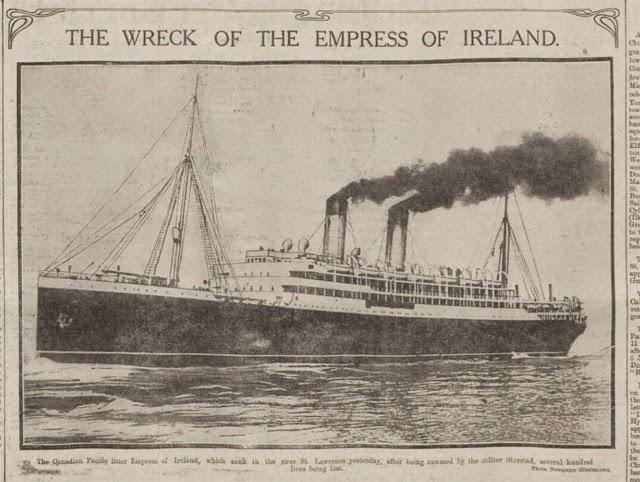
image: The Empress of Ireland


Friday, 30 May 2014

Empress of Ireland Disaster - Thrilling Experiences

Salvation Army Officer's Account.

Rimouski, Friday. -- Thrilling experiences have been related by Salvation survivors of the Empress of Ireland disaster. Captain Wilson of Toronto, shared a cabin with Adjutant Green and Bandsman Johnston, who were saved, and Captain Dodd, of Toronto, who perished. Captain Wilson was awakened by the collision, but thought so little of the matter that he did not get up at first. Finding the ship listing, however, he rose with the others and went out, but owing to the slant of the decks they had difficulty in climbing to the rail. At last after they had noticed the odour of gas there came the roar of a terrible explosion, and Captain Wilson found himself thrown half stunned against the rail, which he grasped. He climbed over and found himself sitting with hundreds of other passengers on the ship's side, which as the vessel settled became almost horizontal.

A few moments later he was in the swirling water. He seized a piece of wreckage as he felt himself being sucked down, and he was under water for a seemingly interminable period. On coming to the surface he twice lost and regained hold of wreckage. The water was intensely cold but Captain Wilson managed to hold on until he was picked up by the second lifeboat which passed, the first being already overcrowded. He was given an oar, but was too benumbed to hold it, and be fainted. The next thing he remembered was being hauled into the Storstadt by a rope.

"When I was trying to reach the rail," related Captain Wilson, "a woman handed her five-year-old girl. I tried to lift the child so that Ensign Pugmire, who was clinging to the rail above me, could grasp it, but he could not reach it. I saw it was hopeless, so just before the plunge I handed the child back to its mother. I did not see them again."

Major Attwell, of Toronto, saved his wife and himself in one of the steamer's useless lifeboats. He found a life belt, and fastened it to his wife. He himself secured an air cushion, and with these the couple kept afloat, although they were sucked under three times when the ship foundered.

Captain Townsend, the officer in charge of the Salvation Army work in Quebec- City, will arrive here to-night to take charge of the bodies of the army victims. His wife was to have sailed by the Empress of Ireland, but was too ill to leave Quebec.


SALVATION ARMY OFFICER RESCUED.


News was received at the Salvation Army headquarters, London, on Saturday, that Capt. Pugmire is among the rescued. This raises the total number of Salvationists rescued to 22, out of about 160 on board, Commissioner M'Kie left London this morning for Liverpool, where he will join the Aquitania. He is proceeding to Canada to take up temporary command there. "We shall all bow our heads in subdued sorrow, but the Salvation Army must march on," said Brigadier Perry to-day.


This article originally appeared in The Witness 2 June 1914.

image: British Newspaper Archive

Empress of Ireland Disaster - The Survivors

THE SURVIVORS.


OFFICIAL LISTS OF PASSENGERS AND CREW


Several lists of the rescued passengers have been issued. The names are as follow --

FIRST CLASS.
F. E. Abbott (Toronto). Lionel Kent (Montreal).
J. R. Abercrombie (Vancouver). Miss Grace Kohl (Montreal).
Mr. and Mrs. P. J. Adie (Birmingham). Miss A. H. Lee.
A. J. Burrows (Nottingham). C. B. Lyon (Vancouver).
R. A. Cunningham(Winnipeg). C. Malloch.
D. A. Darling (London). Mrs. A. E. Mullins (London).
W. Fenton (Manchester). Mrs. H. R. O'Hara and daughter (Toronto).
Miss Doris Gaunt (Birmingham). Mrs. W. E. Patton (Sherbrooke).
P. Godson (Kingston). E. Seybold (Ottawa).
L, A. Gosselin (Montreal). Miss T. Townsend (New Zealand).
G. W. S. Henderson (Montreal). Rev. J. Wallett (London).
Miss J. T. Blyth. C. R. Clark (Detroit).
C. Gallagher (Montreal). Miss H. Taylor (Montreal).
L. A. Hyamson (London). Mr. and Mrs. Harwood Cash (Nottingham).

SECOND AND THIRD CLASS.
K. Abanok. K. Joyo.
P. H. Archer. Y. Kamimicky.
J. Anderson. James Johnston.
A. M. Arikkalam. A. Klamont.
Major Atwell. Adam Koklickach.
Mrs. Atwell. A. Kalebutala.
Miss Ethel Bachi. M. Kutchen.
Miss Edith Boch. J. Krutin.
Bokey P. Bartosch. M. Koczak.
M. Beoocries. Mrs. Kirtley.
Mr. and Mrs. J. H. Black --. Koschriss.
Miss D. F. Blythe. A. Kranchisky.
Elliss Boris. Miss F. Kruse.
T. Bonar Ryak Alfred Keith.
A. Bradley. Rowel Lea.
Mr. and Mrs. W. R. Brooks. H. Lawler.
J. K. Lenaly. Miss A. Lee.
A. Brown. Miss Martha Luren Linquist.
F. Brooks. Laurence L. Barbour.
J. Burns. J. J. Lennon.
G. Buckass. G. Maguire.
E. Byrne. J. Maguire.
B. Brict. Miss F. Maloch.
J. Braga. D. McAmmond.
Eric Burainon. W. H. Measures.
Alice Bales. F. M. Melson.
B. Chamboi. B. Minanch.
Charles Clark. Major Morris
--- Conspanion. S. Missila.
Miss E. Court. T. Munteau.
Jaz. Connor (colour). V. Moore.
J. R. Crombie. H. Mose
R. W. Crellin. --- Musychuk.
Mrs. G. C. Cook. John Murphy.
J. Fergus-Duncan (London). H. Murninnon.
Jack Rubenstein. M. Moseszuk.
W. Davies. Kenneth M'Intyre.
Gordon Davidson. P. Noenickky.
Dennis P. Darling. F. Calender.
D. Datonkist. Julen Patrick.
J. Evanson. Geo. Pott.
S. R. Delamount. W. Paschkowdis(?).
J. R. Delamount. E. Pugmire.
J. F. Elias. A. Pykara.
E. L. Erickson. G. Parkinson.
J. Erzinger. H. Peterson.
A. B. Evans. Mrs. Peterson.
Mr. and Mrs. H. Freman Wm. Quinn.
Buma Fano. Carl Randle.
F. Ferguson. K. Rautain.
A. Ferugay. A. Ranyon.
Tercy Flynn Flack. S. Robekjchenko.
A. Ford. T. Romanechi.--- Shodlak.
J. Fowler. A. Rainyecna.
W. Foss. John Salo.
Dr. James Grant. P. Sanderson.
--- Graywhit. M. Sanconia.
J. J. Gragowitz. Albert Smith.
Mr. and Mrs. Green. A. B. Spooner.
T. and Mrs. Greenway. W. Schakalida.
Martin Gill. A B. Smart.
Ernest H. Green. A. Sobiye.
A. Gray. M. S. Warnstone.
Herbert Greenaway. B. Sosison.
Y. Kanimiski. J. Scotni.
A. Hiller. B. Sundor.
Mr. and Mrs. G. Hedgecock. C. H. Smith.
Dr. Hunt. Miss Schongutt.
U. Holkis. Alan Taylor.
Grace Hannagan. Miss Wilmott.
Grace Hannagan. C. B. Wembauch.
D. Johnson (Fredricton, N.B.) Capt. Wilson, S.A.

MEMBERS OF THE CREW.
The following are the crew saved, so far as can be ascertained up to 7-30 on Saturday evening --

SAILORS.
Bruin, T. Hartford, N.
Brown, W. Hudson, J.
Clarke, J. Jones, D. H.
Downey, T. Jeffries, J. F.
Donnelley, E. Lang. B.
Dennis, T. Moran, J.
Diseley, J. M'Coy, J
Evans, A. M'Ewab, J.
Evans, J. M'Dougall, D.
Fitzpatrick, J. M'Guire, J.
Fawcett, W. Price, J. H.
Fitzgerald, H. Sims, J.
Gratwick, T.

FIREMEN AND TRIMMERS.
Bailey, G. M'Ginniss, R.
Brown, P. Murphy, W.
Campbell, M. Mitchell, J.
Clarke, J. J. Neal, Henry.
Campbell, J. Quinn, J.
Cottle, Sam. Rowlands, T.
Duffy, J. Rockford, M.
Davies, P. Rochford, M.
Davis, J. Rice, E.
Dolan, P. Ryan, T.
Daves, J. Sheridan, P.
Donaldson, J. Smythe, J.
Foster, E. Stephen, J.
Gray, J. Smith, J.
Hayes, E. Toole, J.
Jackson, E. E. Toole, P.
Keegan, J. Whitty, J.
King J. Wilson, J.
M'Ready, T. White, Henry.
M'Ewan, J.

LEADING FIREMEN.
Cassey, J. Murphy, P.
Hood, T. M'Case, J.
Hutchinson, A. Neill, H. D.
Malone, P. or J. Hitty, J.
M'Ginnis, J.

STEWARDS.
Absolon, V. Grieves, G.
Brown, J. Gibson, J.
Challis, M. Green, F.
Cure, A. Griffiths, O.
Clague, R. Hughes, W. R.
Cooke, T. Hughes, W. L.
Campa, W. Hird, W.
Dixon. Hebret, W.
Dumbell, T. Harrison, F.
Donegan, J. Haish, S.
Dixon, A. H. Hayes, J. A.
Flimo, R. Jones, C.
Fireday, A. Jones, O.
Foyle, R. R. M'William.
Grey, A. Metcalf, H.
Gill, H. Myers, J.
Gregory, F. Metcalf, T.
M'Sherry, J. Smith, J.
Owen, W. S. Smith, A. E.
Price, T. Shannon, F. J.
Prouse, J. W. Smith, H. K.
Pritchard, O. Williams, A. C.
Parry, D. Williams, T.
Pritchard, J. Williams, R.
Pitts, W. H. Williams, Jos.
Rowan, W. Gaade, A. W.
Roberts, W. Hollies, H. (stewardess).
Robertson, J.

ENGINEERS.
Brennan, R. H. M'Ewan, J.
Hampton, W. O'Donovan, G.
Johnston. J. A. B. Samson. W.
Liddell, R. R. Smith, A. E.
Moonie, G. Swan, J. H.
M'Donald, C. K. White, J. B.

GREASERS.
Duggan, P. O'Donnell, D.
Darcy, F. Reardon, D.
Holding, S. Summers, J.
Megson, J. Stephens, J.
M'Adam. W. Sheridan, R.
Mahar, T. Williams, W.
Nelson, C.

COOKS AND BAKERS.
Bratithwaite, J. Mathhewa, J. L.
Bishop, T. Rohr, A. S.
Cunningham, J. Sharkey, N.
(-?-)don, H. Shaw, H.
(-?-)tt, A Smith, T. J.
[-?-], P. Turner, J.
[-?-],A. Ventry, J.
Lee, S. Williams, D.
Lewis, J.

SCULLERY AND PANTRY MEN.
Cope, J. Prince, W.
Copplin, G. Thomson, A.
M'Aleavy, P. Wynn, T
Owen, R.

STOREKEEPER.
Burns, C.

QUARTERMASTERS.
Galway, J. Murphy, J.

BOATSWAINS.
Sprague, T. Bradley, A. C.

MARCONI.
Bamford, C. Fergerson, J.

PRINTER.
Duggan, J.

BUTCHERS.
Dawson, A. M'Donnell, H. J.
Knight, R. Paterson, I.

ELECTRICIANS.
Duckworth, W. B. Grant, J.

BAR-KEEPER.
Davis, J.

SECOND OFFICER.
Fife, O.

SURGEON.
Grant, J. F.

BARBER.
Glassberg, R.

ASSISTANT PURSERS.
Hayes, E. Wakeford, C.

BUGLER.
Hobson, S.

FIRST OFFICER.
Jones, E. J.

CAPTAIN
Kendall, H. G. (slightly injured).

BOOTS.
Marl, W. Powell, L.

BELLBOY.
Spencer, C.

MASTER-AT-ARMS.
R. Saunders.

The following deserted at Quebec -- Cooney, J.; Caldwell, J.; Doolan, J.; Mountain, T.; Neil, C. -- total, 211.

The following engineers, ex-Asia, were signed on for passage home -- James Rankin-Scott, W. Albert Smith, Bryan H. Lockhart, J. Homes Scotand -- all reported lost.

The 1914 funeral service for those who drowned on The Empress of Ireland.

MESSAGE FROM MONTREAL.

BODIES IDENTIFIED.

Maginnis, A. G., director of Mappin & Webb, Ltd., London.
Holt, K. E. Toronto.
Goldthorpe, Chas., of Bradford.
Crathern, Miss, Montreal.
Gallagher, Mrs., Winnipeg.
Barlow, Mrs. A. E., Montreal.
Seybold, Mrs., Ottawa.
Bow, Adjutant and Mrs. De, Toronto.
Hannagan, E., Toronto.
Morris, Mrs., Toronto.
Green, Mrs., Toronto.
Findlay, Major, Toronto.
Lavis, Mrs., Toronto.
Potter, Brigadier,Toronto.
Bristow, Mrs., Westminster.
Paavetila and son.
Potter, Brigadier, Montreal.
Wilkes, Toronto.
Major Nettie Lymcoe, Manitoba.
Georgi Zonk and Bladisten Zonk.
Hannan, F. S., Manitoba.
Hunton, Mrs., Salvation Army, Manitoba.
Brooks, Dolly.
Potter, W., Manitoba.
Leonard Palmer, Mrs. W., Toronto.
Archer, Mrs. Hannuanen, E.
Kivolsky, Ivan.
Steele, R., chief officer
Wildman, J., storekeeper.
Braine, E., bedroom steward.
Thompson, G. J., plumber.
Peterson, V., carpenter.
Perry, H., assistant steward.
Pearson, Mrs. S. J., stewardess.
M'Grath, J., assistant steward.
Parkinson, second-class steward.
Rees, Mrs., Commissioner.
Maidment, Colonel.
Potter, Brigadier.
Findlay, Major.
Simcoe, Mrs., Major.
Harry Green, Adjt., and daughter.
Hannagan, Adjutant, and Mrs.
Guido Whatmore, Captain and Mrs.
Morris, Mrs. Staff Captain.

Montreal, Saturday Morning:-- The following is a list of the first class passengers saved -- F. E. Abbot, Toronto; Mr. and Mrs. Percy Adie, Birmingham, England; John Atkinson, A. J. Burrows, Nottingham; R. A. Cunningham, Winnipeg; W. Fenton, Manchester; -- Fallagher; Miss Doris Gaunt, Birmingham; L. A. Gosselin, Montreal; G. W. S. Henderson, Montreal; L. A. Hyamson, London; Lionel Kent, Montreal; Miss Grace Kohl, Montreal; C. B. Lyon, Vancouver; Mrs. O'Hara and daughter, Toronto; E. Seybold, Ottawa; Mrs. W. E. Patton, Sherbrooke; Mrs. A. A. Mullen, London.

The second and third class passengers saved were -- A. Benek, K. Archer, P. H. Anderson, J. Arikkalla,, A. M. Bachi, Miss Ethel Beck, Misa Edith Bartsih, K. Boskey, P. Baccerize, M. Black, Mr. and Mrs. J. H. Blyth, Miss B. P. Boris, Eliss Bomaryak, T. Bardley, A. Brooks, Mr. and Mrs. W. R. Brown, A. Burns, John Buckas, G. Byrne, E. Bract, V. Braga, W. Duraimen, Eric Botha Chamber, E. Clark, Chas. Conspanein Court, Miss E. Cannor, James Colore. D. Crombie, J. R. Davies, W. Davison, -- Gordon, -- Darling, -- Dennis, P. Datoukist, D. Lea,  -- Lowell, -- Lawler, H. Lee, Miss A. Lenaly, J. K. Lias, L. Linquist, Miss Martha Luren Maguire, E. Maguire, J. Maloch, Miss F. M'Cammond, D. Measure, W. H. Melson, F. M. Minanch, B. Missila, S. Munteau, T. Moore, V. Mose, H. Muzychuk, Murphy, John Murninaen, M. Moseszuk, M. Nernickky, P. Oslender, F. Patrick, Julien Pott, George Paschkowdis, W. Pugmire, E. Pykara, A. Quinn, Wm. Evanson, J. Jackson, E. L. Erzinger, J. Evans, A. B. Ferrigay, L. A. Fanobuma, Ferguson, F. Glack, Terey, Flynn, Ford, A. Fowler, J. Foss, W. Grant, Dr. James S. Graywhitz, J. Green, Mrs. Greenaway, T. Gill, Martin, Hanalaino, D. Hilweer, A. Hunt, Dr. Holkis, W. Joil, K. Kamnishi, Y. Klamont, A. Koklinkach, Adam Kaloyutala, Kutchem, M. Kritin, J. Keozak, M. Kairkhley, Mrs. Koschriss Krahchenky, A. Kruco, Miss F. Rubenstein, Jack Randle, Carl Kautala, K. Ramyena, A. Rebeljschenke, Silgor Romanechi, T. Salo, John Sanderson, P. Saneomnia, Monro Smith, Albert Spooner, P. Schakalida, W. Schedlok, Smart, A. B. Sobiye, A. Swarnstone, M. Sosison, B. Scotni, J. Sunder, B. Taylor. Allen Thalie, N. Totin, A. Tatti, Y. Tuchesk, M. Talebkka, A. Valinaki, T. Van Lanks, T. Vroilidvalky, Mrs. Hilda Ventre, A. Walker, A. Williams.

 Unloading the coffins of the children from Lady Gray

OFFICIAL LIST.


The following list, the fouHh to be received of second and third class passenger survivors was issued from the offices of the Canadian Pacific Railway to-day -- K. Abanok, F. H. Archer, J. Anderson, A. M. Arikkala, Major Atwell, Mrs. Atwell, Miss Ethel Machi, Miss Edith Boch, B. P. Bartsch, M. Decocriss, Mr. and Mrs. J. H. Black, Miss B. F. Blyth, Eliss Boris, T. Bonarynk, A. Bradley, Mr. and Mrs. W. R. Brooks, A. Brown, J. Burn, C. Buchas, E. Byrne, J. Braga, E. B. Burkinson, Florence L. Barbour, Alice Bales, E. Chamboi, Clark Conspanin, Miss E. Court, J. Connor (coloured), J. R. Crombie, R. W. Crollin, Mrs. G. E. Cook, W. Davies, G. Davidson, D. P. Darling, P. Datonkist, J. Evanson, E. L. Erickson, J. Erzinger, A. B. Evans, Mr. and Mrs. Freeman, Buma Pano, F. Ferguson, A. Ferrigay, Flack, Tercy Flynn, A. Ford, J. Fowler, W. Foss, Dr. John Grant, Graywhit, J. Grazowitz, Miss Green, T. Greenaway and Mrs. Greenaway, Martin Gill, Ernest H. Green, A. Gray, Herbert Greenaway, D. Kanalaino, A. Miller, Dr. Hunt, A. Holkis, Grace Hannagen, K. Joel, Y. Kamanishi, A. Klamont, Adam Kiklickach, A. Kalevutala, M. Kutchen, J. Krutin, M. Koczah, Mrs. Kirthley, Koschriss, A. Kranchisky, Miss F. Kruso, Alfred Keith, Rowell Lea, S. Lawler, Miss A. Lee, J. K. Leneley, L. Liss, Miss Martha Luren, Linquet, J. J. Lennon, G. Maguire, J. Maguire, Miss F. Maloch, D. Moannond, W. H. Measure, F. M. Melson, B. Minanch, S. Missila, T. Munteau, V. Moore, H. Mose, Muskchuk, John Murphy, M. Murninson, Moses Zuk, Kenneth M'Intyre, P. Noenickky, F. Calender, Julien Patrick, George Pott, W. Paschkowdis, E. Pugnire, A. Pykara, C. Parkinson, H. Peterson, Mrs. Peterson, Wm. Quinn, Jack Rubenstein, Carl Randle, K. Rautala, A. Renyona, Silgor Robeljchenko, T. Romanechi, John Salo, P. Sanderson, Moro Sancomia, Albert Smith, R. P. Spooner, W. Schakalida, Shodlok, A. B. Smart, A. Sobive, H. Swarnstone, B. Sosison, J. Scotni, B. Sundor, C. H. Smith, Miss Schongutt, Allan Taylor, N. Thalie, O. Totin, Y. Tatti. N. Tuchoskm, A. Talrobkka, T. Valinnke, T. Van Lanki, Varvited, Mrs. Hilda Valky, A. Ventro, A. Walker, J. Williams, Miss Wilmott, and C. B. Weinranch. The following is an additional list of first cabin passengers rescued -- G. Bogue, Smart, Mr. Cox Edwards, Mr. A. K. Wakeford, and his son, who was assistant purser of the ship; also the following second class passengers -- Mrs. Davies, Mr. T. Johnson, Mr. Herman Kruse, Mr. and Mrs. R. Simmonds, and Mr. W. Turpin.

THE CREW.

Frederick Glynn, steward; Archibald Thompson, steward; Patrick Brown, fireman; W. Williams, greaser; Towland Ferguson, chief Marconi operator; Patrick Hoian, cook; F. Faige, cook; H. Mellen, steward; C. Burns, storekeeper; T. Flood, fireman; A. E. Smith, steward; W. Herbert, steward; R. Williams, steward; B. Malone, fireman; J. Moran, seaman; John Cook, pantryman; Daniel J. Jones, seaman; John Ryan, fireman; Tom Ryan, fireman; Edwin, cook; Charles H. Spencer, bellboy; John Gunn, trimmer; David Williams, cook; Percy Gee, steward; B. Absolon, steward; Miss B. T. Blyth, maid; T. Price, steward; A. Mill, cook; J. Vemtry, cook; H. Clandon, cook; T. Douglas, baker; R. Knight, butcher; John Hudson, A.B.; E. Bamford, jun., Marconi operator; A. Hind, steward; Thomas Williams, chief second steward; W. Grey, steward; N. Wakesford, assistant purser; A. Grant, electrician; J. King, engineer; William Adam, engineer; R. M'Lay, engineer; W. Fawcett, A.B.; F. Norman, bandmaster; A. Hemberton, musician; H. Shaw, baker; George Bailey, fireman; John Connor, greaser; H. B. Childs, musician; J. Mitchell, trimmer; S. Clarke, trimmer; P. Holland, cook; J. Turner, cook; P. Murphy, fireman; P. Dollan, trimmer; G. Megson, greaser; Henry White, trimmer; B. Long, A.B.; B. Davidson, storekeeper; John Whitley, fireman; Robert Sander, master-at-arms; A. Whitley, fireman; James M'Coy, storekeeper; B. Bishop, assistant cook; W. H. Hughes, steward; W. H. Pick, steward; H. Burrill, steward; C. Jones, steward; C. Williams, steward; G. Metcalf, steward; E. H. Swan, tenth engineer; W. S. Owen, steward; choreboy Officer; Mrs. Hollis, stewardess (the only stewardess saved); K. J. M'Henry, butcher; A. Symon, cook; E. Matthews, chief cook; Thomas M'Dougal, fireman; P. J. Smith, baker; A. Elliott, baker; W. G. Aade, chief steward; D. B. Buskworth, electrician; W. Malone, firenan; T. Molson, greaser; F. Baker, steward; J. Hayes, steward; M. Challes, steward; Captain Kendall; -- Johnston, chief engineer; John Brown, steward; James M'Ewan, fourth engineer; D. M'Dougall, A.B.; O. Pinner, steward; P. Murrfur, fireman; T. Mumbell, steward; A. Dunner, trimmer; F. Gregory, steward; A. Stevens, fireman; R. R. Little, third ergineer: S. S. Hodgson, officers' steward; Charles Jackson, fireman; H. Claigue, steward; P. Metcalfe, steward; P. Mountain, fireman; H. J. Houghton, trimmer; W. Clark, fireman; G. Sheredein, greaser; G. A. Stevens, greaser; J. Jeffrey, greaser; J. Holden, greaser; J. M'Coman, fireman; J. Clark, seaman; H. Jacques, steward; J. Poul, fireman; B. Readem, greaser; J. M'Kay, fireman; B. M'Donnell, greaser; A. E. Smith, engineer; T. K. M'Donald, extra fourth, engineer; O. Jones, steward; W. Brown, seaman; J. Campbell, fireman; J. Smyth, trimmer; J. M. Campbell, trimmer; J. M'Innes, trimmer; J. Simmes, seaman; E. H. Jones, seaman; J. Price, seaman; J. Smith, steward; O. Pritchard, steward; C. Parkinson, steward; T. M'Inness, fireman; T. Duggan, greaser; -- Dunnigan, steward; G. Grives, steward; R. Owen, steward; C. Cook, steward; J. A. Dugan, assistant printer; C. Copplin, pantryman; A. Dawson, butcher; -- Braithwaite, second baker; John Wilson, fireman; -- M'Etan, seaman; J. Keegan, trimmer; J. Fitzpatrick, seaman; -- Bohr, confectioner; Meonie Hunior, third engineer; Robert Brennan, jun., second engineer; A. Johnston, eighth engineer; J. D. White, seventh engineer; L. M. M'Donald, steward; J. Pulchard, steward; W. Cowan, steward; J. Gibson, steward; J. Geseby, A.B.; M. Hartford, A.B.; T. O'Toole, trimmer; A. Lewis, cook; F. Cuttles, trimmer; P. M'Alevice, oook; J. Patterson, butcher; A. H. Dickson, steward; H. R. Molland, steward; W. Roberts, steward; E. Shannon, fireman; A. Cure, steward; Rockford, fireman; W. Quinn, trimmer; A. Matthews, trimmer; M. Summer, fireman; Slasburg, barber; A. Gray, steward; M'Donald, butcher; Maul, steward; Powell, steward; Perry, steward; Nugent, steward; Mudtoch (Murdoch?), steward; D'Arcy, greaser; Edward Wright, fireman; G. Bradwicks, seaman; T. Downey, seaman; John Davids, trimmer; James M'Gill, seaman; S. Harrison, steward; B. Rius, seaman; Pat. Maher, greaser.

IDENTIFICATION OF THE BODIES


Quebec, Monday. -- The identification of the bodies is proceeding slowly. Those already recognised include H. Debond, Liverpool; W. B. Graham, Hong Kong; Mrs. Brigadier Hunter, India; Mrs. W. Jones, Briarly Hill; Mrs. Ledgers, stewardess; Colonel Maidment, Sydney, and Mrs. Maidment; Jack Murphy, waiter, Liverpool; Gordon A. MacGinnis, of London; H. Newham, steward; Mrs. W. Leonard Palmer, London; Mrs. H. Wynne, New Zealand; Mrs. Peerson, Liverpool; Mr. Steele, chief officer; Mrs. Clara Vincent. Weymouth.


This article originally appeared in The Witness 2 June 1914.

image top: Emigrants on the Empress of Ireland
image middle: Funeral of victims in 1914
image bottom: Unloading the coffins of the children from Lady Gray

Empress of Ireland - Cause of the Disaster

A FULL INQUIRY.

ROYAL SYMPATHY

TRAGIC PARAGRAPHS.

Empress of Ireland Enquiry

In the House of Commons at Ottawa on Saturday Mr. Borden, the Premier, read messages of condolence with the families of those who were lost in the wreck of the Empress of Ireland from the King and Queen, Queen Alexandra, the Duke of Connaught, Prince Alexander of Teck, Princess Louise Duchess of Argyll, Mr. Lewis Harcourt, and Mr. Massey, Prime Minister of New Zealand, on behalf of the Government and people of that Dominion.

Mr. Borden, replying to the last message, expressed Canada's sympathy with the New Zealanders who were bereaved by the disaster.

It is announced, says Reuter, that the Government will immediately introduce legislation to authorise the appointment of a specially constituted Commission of three members to investigate the wreck. The Imperial Government will be asked to appoint one Commissioner, while the Canadian Government will be asked to appoint two Judges with experience in Admiralty cases.

A representative of the Board of Trade left London for Ottawa yesterday morning to confer and co-operate with the Canadian authorities in connection with the inquiry.


THE SALVATION ARMY VICTIMS

A telegram received at the International Headquarters of the Salvation Army states that the following bodies have been recovered -- Mrs. Commissioner Rees (not Commissioner Rees as previously reported), Colonel Maidment, Brigadier Potter, Major Findlay, Mrs. Major Simcoe, Adjutant Harry Green and daughter, Adjutant and Mrs. Sannagan, Adjutant and Mrs. Deebow, Captain Guido Whatmore, and Mrs. Staff Captain Morris.

The statement cabled from Montreal that Major Morris had carried Commissioner Rees upon his back is a mistake.

General Both has received, the following message from the president of the Canadian Pacific Railway Company -- "Although satisfied that the terrible accident was due to causes beyond our control, the company's officers are filled with sorrow that there should have been such a serious loss of life, including so many members of your Army, among the passengers travelling under our control, the company's' officers are filled with sorrow that there should have been such a serious loss of life, including so many members of your Army, among the passengers travelling under our auspices. Be assured that you have my most sincere sympathy. -- Shaughnessy."

The Mayor of Toronto has also cabled -- "Toronto sorrows with you."

It was stated at the Salvation Army Headquarters to-day that Commissioner M'Kie, who left for Canada, on Saturday, would superintend the burial of fine bodies of the Salvationists. Up to the present only thirteen bodies out of 171 have been found. They hoped the survivors would be able to renew the journey and attend the International Congress.

Toronto, Saturday. -- Outside the Salvation Army Temple here a scene, tragic in its sadness, was witnessed yesterday. The list of the known survivors of the army delegates was read out, the twenty-two names having been telephoned direct from Rimouski to Colonel Rees, of the Toronto headquarters. On the steps of the building on the side walk, and inside the main doors crowds gathered to hear the list read. Hopes were high when the names were first read, but when so many were found to be missing from the 165 who left aboard the Empress of Ireland the scene was heartrending. There were no loud outbursts of grief, but eyes were filled with tears, and handkerchiefs were in every hand. Those who derived comfort from the fact that friends were saved tried to console the less fortunate. Even the hope raised by the officer who read out the list could not change the sadness of these, as once before hopes raised were destroyed a short time later when the report that all were saved was found to be false. Upstairs in the private offices women who had relatives on board the ship waited to the last moment, and before they went away the news was broken that loved ones were among the missing.

CANADIAN CITIES IN MOURNING

Montreal, Saturday. -- The disaster will be felt with particular keenness in practically every city and town of importance in Canada. Commencing in Montreal, with a list of twenty one passengers, those aboard came from every city clear through to Vancouver. Toronto had the largest representation, with a list of close on 150, chiefly composed of members of the Salvation Army and their friends. Vancouver, too, had a large list of passengers on board.

ONE OF THE SURVIVORS.

Among the first-class passengers in the ill-fated vessel was Mr. A. Hirst, of Birmingham, well known in Belfast. Yesterday, as his name had not appeared in the list of rescued, his friends mourned him as dead. But this morning his name is among the survivors with no worse results than a dislocated shoulder. Formerly he was the representative of Messrs. & Ball & Sons, of Birmingham, but for the past two years he has travelled for Messrs. Tonks, Ltd., of that city. For the past ten years he spent practically three months of each year in Belfast and during these visits he made a host of friends, who will all be glad to learn that they may hope to look on his pleasant and genial face again.

PROMINENT ORANGEMEN'S SAFETY.

When the news of the foundering of the Empress of Ireland was first published it was rumoured that amongst the passengers was Mr. Frederick Dane, «f Toronto, Grand Master of the Province of Ontario West, and secretary to the Grand Orange Council of the World. It has, however, transpired that Mr. Dane left Canada earlier than he originally intended, and has just arrived in Glasgow by the Allan liner Grampian. Much gratification was expressed by his colleagues on learning of his safety. Mr. Dane is a Belfast man, and two years ago he was elected secretary of the Orange Council, familiarly known as the "Triennial Council."

NOTABLE PERSONS MISSING.

Distinguished passengers who have not yet been accounted for, and who are known to have been in the liner, include --

Sir Henry Seton-Karr, the big game hunter.
Mr. Laurence Irving, the well-known actor.
Miss Mabel Hackney (Mrs. Laurence Irving).
Commissioner Rees, head of the Salvation Army in Canada, and Mrs. Rees.
Mr. W, Leonard Palmer, of the "Financial News," London.
Lieutenant-Colonel Bloomfield, Auckland, New Zealand, Mrs. Bloomfield, and Miss Bloomfield.
Mr. A. G. Maginnis, director of Messrs. Mappin & Webb.
Mr. A. B. Anderson, managing director of Ferranti, Ltd., Kingsway.
Mr. G. Bogue Smart, Department of Immigration.
Mr. A. Black, of the firm of J. R. Booth.

IRISH MARCONI OPERATOR.

The chief Marconi operator at Father Point, who was called up by the sinking Empress of Ireland, is Mr. Whiteside, of Ballymena, County Antrim, Mr. Whiteside, who was formerly on duty at Sable Point, was also the first man at a land station to get the "S.O.S." from the sinking Titanic.

A Marconi operator at Rimouski gives the following account of the sinking of the liner -- The Empress of Ireland was rammed this morning at 1-45 by the Storstad twenty miles from Father Point. The Empress of Ireland sank within ten minutes. A "S.O.S." signal was sent out, and was received at Father Point. The Government steamer Eureka and the Lady Evelyn were despatched immediately to the distressed vessel's assistance.

The Empress of Ireland listed, and it was impossible to get out many boats. Captain Kendall was saved, being picked up on some wreckage by No. 3 lifeboat thirty minutes after the ship foundered. The assistant-purser, chief engineer, and chief steward were saved. The chief officer and purser are among the missing.

THE KING'S SYMPATHY.

Among the earliest callers at the C.P.R. offices in London on Saturday was Mr. John Burns, who made inquiries on behalf of the King as to the number rescued from the Empress of Ireland. Mr. John Burns made frequent visits to the C.P.R. offices yesterday largely at the behest of his Majesty, who telegraphed the President of the Board of Trade desiring all particulars.

Late on Friday a telegram was received by Mr. Burns from Lord Stamfordham expressing his Majesty's deep sorrow and regret at the disaster, and expressing the sympathy of their Majesties with the relatives in their bereavement.

The following message was sent on Saturday to the King by the Canadian Pacific Railway -- "On behalf of the Canadian Pacific Railway I may be permitted to thank your Majesty for your Majesty's most gracious expression of sympathy conveyed to us through the Right Hon. John Burns, with the friends and relatives of those who have lost their lives or who have suffered in the appalling disaster to the Empress of Ireland. -- (Signed) G. M'LATREN BROWN, European Manager."

The following is a copy of the telegram sent to Sir Thomas Shaughnessy at Montreal by the King: -- "In the appalling disaster which has befallen your company by the loss of the Empress of Ireland, in which, alas, so many lives have perished, I offer you my sincere sympathy." -- GEORGE R.I."

His Majesty has also sent to the Duke of Connaught, the Governor-General of Canada, the following telegram -- "I am deeply grieved at the awful disaster to the Empress of Ireland, in which, alas! so many Canadians have lost their lives. The Queen and I assure you of our heartfelt sympathy with those who mourn for the loss of their relatives and friends." -- GEORGE R.I."

Queen Alexandra has sent the following cablegram to the Duke of Connaught -- "The terrible disaster that has occurred to the Atlantic liner Empress of Ireland in the St. Lawrence River grieves me more than I can say. Up to last night we had hoped in London that most, if not all, lives had been saved. But this morning I learn that the first sad report was too true, and that over one thousand people had been drowned. I wish to express to you my most intense sorrow at this awful catastrophe, and to beg of you kindly to see that my heartfelt sympathy may be conveyed to the relatives of all those who have perished. -- ALEXANDRA."

THE MANSION HOUSE FUND.

The King has subscribed £500 and the Queen £250 to the Mansion House Empress of Ireland Fund.

FRENCH SYMPATHY.

Paris, Saturday. -- The news of the disaster, which became known in Paris through the medium of the afternoon papers, caused widespread consternation. The offices of the Canadian Pacific Railway Company were almost immediately besieged by anxious inquirers, the majority of whom were British or American.

President Poincare, on being informed of the disaster, immediately sent a message of sympathy to King George.

M. Viviani, the Minister of Education, who is temporarily replacing the Minister of Marine, also sent a telegram to the First Lord of the Admiralty.

SIR H. SETON KARR'S BODY FOUND.

Quebec, Monday. -- Seventy-five bodies have been identified, amongst them, being the body of Sir H. Seton Karr, identification in this case being established by Mr. Elliott, the marine superintendent of the C.P.R. -- Central News.

LISBURN PASSENGER ABOARD

There is much anxiety in Lisburn concerning the fate of Mr. John Scott, whose name appeared in the list of second-class passengers in the ill-fated Empress of Ireland. He belongs to Ravarnett, and has been in Canada for the past year and a half, having settled in Saskatchewan, where he had a farmstead, but he had recently disposed of it, and at the beginning of the present week Mr. Hall (managing clerk in Mr. J. D. Martins, auctioneer) received a letter from him stating he was returning home by the Empress of Ireland. There is a ray of hope that he is amongst the saved, as the name "Kingscott" is queried, and may be the two names joined -- King and Scott. The corrected list is awaited eagerly by his friends.

DISASTER PARAGRAPHS.

Ottawa, Monday. -- The Minister of Marine has received a cable from the Admiralty stating that the H.M.S. Essex has been placed at the disposal of the authorities to assist in the recovery of the bodies from the Empress of Ireland.

The steamer Glendele, under charter by the Dominion Coal Company, as was the Storstad grounded on Saturday near Father Point. She floated on the succeeding tide.

Montreal, Monday. -- A despatch from Father Point reports that the Grampian has picked up two of the boats of the Empress of Ireland. Both was empty.

An automobile patrol has been established along the coast.

Mr. S. Taunton, one of the executive officers of the Canadian Pacific, states that Captain Kendall has been exonerated by the Canadian Pacific of blame. -- Central News.

Quebec, Monday. -- Scores of the dead will undoubtedly have been buried before they can be identified. A pitiful scene occurred yesterday when two men claimed the body of a child as theirs. The case has been referred to the Mayor.

A party of five electrical engineers from Glasgow were on the Empress of Ireland. Four are believed to have been lost. They are -- James Rankin, Walter Scott, Albert Smith, H. Bryand, and J. Lockhart, and were formerly engaged at Fairfield Shipbuilding Yard. A telegram to Glasgow reports Smith saved. The passengers also included a party of nine, including William Russell, two daughters, son-in-law, and grandchildren, for Lanarkshire.

The Press Association learns that the master of the Empress of Ireland was Captain Kendall, who was in charge of the steamer Montrose when Dr. Crippen, the Hilldrop Crescent murderer, was arrested. Captain Kendall only took charge of the Empress of Ireland on her outward voyage from Liverpool. He had been in the company's service about ten years.


This article originally appeared in The Witness 2 June 1914.

image: en.wikipedia.org/wiki/RMS_Empress_of_Ireland

Empress of Ireland Disaster - The Storstad

THE COLLIDING VESSEL.

EMPHATIC STATEMENTS ON BEHALF OF THE STORSTAD

Montreal, Monday. -- The Storstad has arrived here. The collier appears to have been comparatively slightly damaged by her collision with the Empress of Ireland. Immediately upon the vessel's arrival she was seized, by the Sheriff, acting under a writ which has been granted to the Canadian Pacific Railway Company, who have presented in the Quebec Admiralty Court a claim for two Million dollars damages against the Storstad's owners. Captain Anderson has not yet broken the rule of silence which he has imposed upon himself since the disaster occurred, and the members of his crew have been almost equally taciturn.

From the guarded statements which have been made to the inquiry of Pressmen, however, it is gathered that Captain Anderson was not on duty at the time of the collision, and that the Storstad had been ordered astern before she struck the Empress.

When the writ was nailed to the Storstad's mast, Captain Anderson demanded, "By what authority do you board my vessel and place it under arrest?" The Deputy Sheriff replied that his authority was the authority of the British Empire.

Captain Anderson had a conference, with Mr. Lange, chief representative in America of the Maritime Steamship Co., and it was semi-officially stated afterwards that the captain had reported that the Storstad did not back away from the Empress of Ireland after the collision. On the contrary, the collier steamed ahead, making every effort to keep her bows in the hole dug in the side of the Liner. It was the liner which backed, according to Captain Anderson's version, and so doing the Empress of Ireland bent the Storstad's bow in an acute angle towards her port beam. Then the liner became hidden from the sight of the Storstad, and, despite the blowing of his whistles, Captain Anderson was unable to locate the stricken ship until the cries of the victims were heard.

Captain Anderson denies that the Storstad was a mile away from the liner after the collision. He declares that the collier did not move, but that, on the contrary, the Empress of Ireland changed her position. -- Central News.

Montreal, Monday. -- A statement issued on behalf of the captain of the Storstad was read by Mr. J. W. Griffin, of New York, representing the owners. Questioned afterwards Mr. Griffin said that Captain Andersen said he heard Captain Kendall shout through the megaphone, "Don't go astern." Captain Anderson replied, "I won't. I am going ahead" Mr. Griffin said if there had been any real way on the Storstad she would have sheered through the Empress like paper.

OFFICIAL STATEMENT.


Montreal, Monday (Later). -- Captain Lange, the agent of the Maritime Steamship Company of Norway, the owners of the Storstad, issued an official statement after his conference with Captain Anderson, in the course of which he said:--

"It is not with the desire to condemn others, but simply because it is felt that the public is entitled to knew the facts that the following statement is put forward. The vessels sighted one another when far apart. The Empress was seen off the port bow of the Storstad. The Empress's green starboard light was visible to those on the Storstad. Under these circumstances the rules of navigation gave to the Storstad the right of way. The heading of the Empress was then changed in such a manner as to put the vessels into such a position as to pass safely.

"Shortly afterwards the fog enveloped first the Empress and then the Storstad. The Storstad's engines were at once slowed down, then stopped. Her heading remained unaltered. Whistles from the Empress were heard on the Storstad's port bow, and answered. The Empress was then seen through the fog close at hand on the port bow of the Storstad. She was showing a green light, and making considerable headway. The engines of the Storstad were at once reversed at full speed, and her headway nearly checked when the vessels came together.

"It has been said that the Storstad should not have backed out of the hole made by the collision. She did not do so. As the vessels came together the engines were ordered ahead for the purpose of holding the bow against the side of the Empress, thus preventing the entrance of water into either vessel. The headway of the Empress, however, swung the Storstad around in such a way as to twist the Storstad's bow out of the hole and bend the bow itself over to port. The Empress at once disappeared in the fog."

The statement adds that the boats of the Storstad immediately put off, and rescued about 350 persons, who were taken aboard, where everything was done for their comfort. The statements that there was the slightest delay on the part of the Storstad in rendering prompt and efficient aid did a cruel injustice to the captain, who did not hesitate to send out every boat he had, in spite of the desperate condition of his own ship.


This article originally appeared in The Witness 2 June 1914.

image: secure.flickr.com/photos/museemccordmuseum/7556142348/

Empress of Ireland Disaster - Captain Kendall's Story

CAPTAIN KENDALL'S STORY

HOW THE DISASTER OCCURRED

SIGNALS TO THE STORSTAD

VESSEL SEEN TWO MILES AWAY

Captain Henry Kendall
Rimouski, Saturday. -- Captain Kendall, giving evidence at the inquest on the victims of the disaster to-day, said he saw the Storstad two miles away before the fog obliterated her from view. He immediately stopped the ship, rang full steam astern, and at the same time blew three short blasts with his whistle, meaning, "I am going full speed astern."

The captain added that the Storstad's whistle answered one long blast.

Soon after he blew two long blasts on his whistle, meaning that his ship was underway, but had stopped and had no way upon her. This also was answered by the Storstad. Two minutes later the Storstad's starboard and port light loomed up in the fog. The Storstad was a ship's length away.

Captain Kendall said that he shouted through a megaphone at the Storstad to back water, and at the same time had his own vessel go full speed astern, in order to try to avoid a collision.

After the Storstad's bows had cut into the Empress between her funnels, Captain Kendall asked her to keep full speed ahead and fill up the hole she had made, but the Storstad backed away, and the water rushed in.

Captain Kendall then tried to beach his vessel, but the water put the engines out of commission three minutes after the collision.

GETTING OUT THE BOATS

Captain Kendall, continuing his evidence at the inquest, said, that almost immediately after the engines had stopped the ship filled. She was going over all the time to starboard.

"I had in the meantime," he continued, "given orders to get the lifeboats launched. I rushed along the starboard side of the boat deck and threw all the gripes out for Nos. 1, 3, 5, and 7 boats. I then went back to the bridge and ordered the chief officer to send someone to tell the wireless operators, to send out signals of distress. He told me this had been done. I then said, "Get the boats out quick." It is possible that this was the last I saw of the chief officer.

"In about three or five more minutes the ship overturned and foundered.

"I was shot into the sea from the bridge and taken down in the suction.

"The next thing I remember was seizing piece of grating. How long I was on it I do not know. I heard some men shout from a lifeboat, 'There's the captain; let's save him.' They got me into the, boat. There were already about thirty people in it. I did my best with the people in the boat to assist in saving others. We pulled around and picked up twenty or twenty-five more. We also carried about ten in the water around the sides of the boat with ropes around the sides of the boat with ropes around their wrists, hanging on.

"Seeing that we could not possibly save any more, we pulled for the Storstad, which was then about a mile and a half away.

"I got all these people on the Storstad, and left her, with six of the crew, and went back to try and save more. When I got there everybody was gone. I searched around, and could not find anybody alive, so returned to the Storstad."

THE CAUSE OF THE COLLISION

"What was the cause of the collision?" asked the Coroner.

"The Storstad running into the Empress, which was stopped," answered Captain Kendall.

A juror asked whether he received any answer when he told the captain of the Storstad to stand fast.

Captain Kendall replied in the negative. He maintained that it would have been impossible for them not to hear. "I shouted five times," he said, "and later also I shouted to keep ahead. If he did not hear that, he should have done that. As a seaman should have known that."

Was there a wind? It was quite still. When he backed away I shouted to him to stand by.

The captain further testified that he heard no explosion. He thought the so-called explosion was the rush of air from the hull as it filled. There were boats enough for all, and there was no panic. He had full control of the crew to the end. About four boats got away. These boats, whose gripes witness loosed, as the water rose floated away. The people were saved by the Empress's boats and the wreckage.

The Norwegian collier, Storstad, after colliding with the Empress of Ireland


CHIEF ENGINEER'S STATEMENT

Chief-Engineer Sampson was too ill to appear at the inquest, and his testimony was taken at his bedside. He said -- I was in the engine-room until the lights went out and there was no more steam. I had great difficulty in reaching the decks owing to the list, and I had no sooner got on deck than the life-boats which broke loose swept down on me, carrying me under. When I came to the surface I was under a lifeboat, entangled among wreckage. There was no explosion of any kind. I believe that if the Storstad had stuck to us we should have reached the shore.

The inquest was adjourned for a week, and Mr. Coroner Pinault in the meanwhile will take steps to determine what can be done to obtain the evidence of the captain and crew of the Storstad.

EVERY PRECAUTION TAKEN

Statement by Sir Thomas Shaughnessy.

Sir Thomas Shaughnessy, President of Canadian Pacific Railway Company, has issued the following statement --

"The catastrophe, because of the loss of life, is the most serious in the history of the St. Lawrence route. Owing to the distance of the nearest telegraph or telephone stations from the scene of the wreck, there is unavoidable delay in securing official details, but we expect a report from Captain Kendall in the course of the afternoon. From the facts as we them, it is apparent that about two o'clock this morning the Empress of Ireland, when off Rimouski had stopped in a dense fog, was rammed in the port side by the Norwegian collier Storstadt in such a manner as to tear, the ship from the middle to the screw, thus making the watertight bulkheads with which she was provided useless. The vessel settled down in fourteen minutes. The accident occurred at a time when the passengers were in bed, and the interval before the steamship went down was not sufficient to enable the officer's to rouse the passengers and get them into the boats, of which there were sufficient to accommodate a very much larger number of people than those on board, including the passengers and crew. That such an accident should be possible in the river St. Lawrence, to a vessel of the class of the Empress of Ireland, with every possible precautions taken by the owners to ensure the safety of the passengers and the vessel, is deplorable. The saddest feature of the disaster is of course the great loss of life and the heartfelt sympathy of everyone concerned with the company goes out to the relations and friends of all those who met their death in the ill-fated steamship."


This article originally appeared in The Witness 2 June 1914.

images: www.lynximages.com/empresstwo.htm

Great Liner Sunk - Appalling Canadian Disaster


GREAT LINER SUNK

Collision in a Fog.

APPALLING CANADIAN CATASTROPHE

One Thousand Lives Lost.

STORIES OF SURVIVORS.

Passengers Drowned in their Berths

The great Canadian liner Empress of Ireland was run down and sunk off Father Point, in the River St. Lawrence, early on Friday morning.

She left Quebec for Liverpool on the previous afternoon, and encountered a fog, which compelled her to stop.

While stationary she was struck by the Norwegian collier Storstad, and the port quarter from nearly amidships to the propeller was torn completely away.

The ship only kept afloat for a very few minutes. The water rushed through the riven side so quickly that most of the passengers were drowned in their berths.

The latest revised, reports state that the number of lives lost was 1,021. The number on board is given as 1,467, and the saved 446.


Quebec, Saturday. -- Little by little as the relatively few victims of the Empress of Ireland disaster who have emerged from the ordeal alive can be induced to tell their stories the full import of that night of horror becomes apparent. The outstanding impression among them all is the rapidity with which the tragedy was enacted. There was no time to put on lifebelts, no time even for the officers or stewards to rouse sleeping passengers below. The waters of the St. Lawrence settled over the great ship and converted her into a vast steel tomb.

The collision was quickly followed by the explosion of the ship's boilers, and to add to the terror of the situation the dynamos gave out, and the mass of people fighting for their lives were pitched into inky blackness. Mr. Philip Lawler and others among the rescued say that the explosion was terrific, and as it so quickly followed the collision it was evidently caused by water reaching the boilers. The people were simply catapulted into the sea.

"I Was Pushed Overboard."

"I was pushed overboard," Mr. Lawler said, "with my wife and my son, aged fifteen. The boy swam, and I was holding up my wife, but I had to let go of her, and she sank."

Dr. Johnston, chief medical officer of the ship, declared that if the Storstad had not backed away so soon there would have been a larger number saved. When the collier pulled away the sea surged into the hole she had made, and the liner foundered with amazing rapidity. The chief Marconi operator, Mr. Hayes, said -- "As soon as I felt the shock I was I ordered to call for help. Father Point quickly answered, but I could not talk with him, as five minutes after the impact the dynamos failed. Seventeen minutes later the ship sank."

Mr. M'Intyre, a member of this Salvation Army said -- "When I reached the deck I found the people standing about. There were no lifeboats there." When the vessel foundered Mr. M'Intyre swam in the direction of the collier, which rescued him. He declared that when he reached her the collier was all lighted up, and many of the rescued were aboard. The majority were scantily clad.

Liner Turns Over.

Major Attwell, of Toronto, who with his wife are among the saved, declared that the impact was only a slight one, and he was surprised afterwards at the awful consequences it had. When he tried to reach the deck he found it almost impossible to do so I owing to the list of the ship, which was lying wallowing on her side. As he swam on his back in the icy waters he heard a dull explosion, followed by a burst of steam, which spread to all parts of the vessel. Then the liner quickly turned over.

"It seemed as if we had turned turtle," he said. "I think many of the first class passengers were saved. I saw only one first class boat lowered. The weather was virtually calm. The behaviour of the crew on the whole was good, though it must be said the men hardly had time to effect rescues systematically, as the vessel was sinking before the crew or anybody else realised it. The crew tried to launch a boat over the upturned side of the Empress, but it was impossible owing to the list."

The Fate of Mr. and Mrs. Irving.

Mr. Clayton Burt, of Toronto, who is probably the last man who saw Mr. and ' Mrs. Laurence Irving alive, said "they sat at my table in the dining-room. They came along as I stood on deck and asked me what was the matter. I said, 'Save yourselves; we are sinking.' Mr. Irving went to his cabin and returned with two lifebelts. One he placed round his wife, the other he put round him. I then climbed the rail and urged him to follow me. He said he was coming, and as I looked bake I saw him and his wife climb the rail. I sank down to the water's edge. Then the explosion occurred, and as the ship made the final plunge I dived. When I came to the surface I met Miss Thompson, of New Zealand, who begged me to help her. I caught a floating suit case, to which we both held on till we were saved. Only two children are known to have been saved. One is Gracie Hanagan, aged eight, daughter of a leading bandsman in the Salvation Army. Her mother and father were drowned. The child was thrown into the water, where she seized some wreckage and floated until she was picked up."

Mr. J. Fergus Duncan, another passenger, of London, declared that when, the first boat was lowered she fell bow foremost into the water owing to a fault in lowering. When he heard the crash he went on deck and saw the collier moving away, while the frightened passengers were asking what had happened. They began doning lifeboats, and it was awful, he said, to see poor women without strength to keep hold of the railing as they were hurled back against the cabins.

A GRAPHIC STORY.

One of the most graphic stories of the wreck is that told by Mr. Fergus Duncan, of London. "I was in my bunk when I heard three whistles, which meant 'I am keeping my course.' A moment later came two short blasts, signifying 'I have stopped.' I was scared and jumped hastily out of bed and started to dress. Then, the engines stopped suddenly, and a moment later they were reversed. I could see through the port hole that there was a dense fog. There came a terrific crash. The ship heeled over, and there was a frightful grinding noise and smashing of plates. I ran on deck half dressed. But as I got there the steamer listed much that I could hardly get away. There was not the slightest chance to lower the lifeboats owing to the list. All stuck in the davits, and those who could get lifebelts, but the time was too short with many even to put them on."

Asked as to the behaviour of the crew, Mr. Duncan said that so far as he could see they behaved well. There was no sign of panic among then. "Of course," Mr. Duncan went on, "there was disorder, as was to be expected in such frightful emergency, but I saw members of the crew helping passengers, and saw several men hand their lifebelts to women. I had left my lifebelt in the cabin, but I met a man who had two, and he gave me one, otherwise I should not be here.

A Struggle for Life.

"While we were all in this" confusion the ship gave a sudden lurch, and the whole lot of the passengers were rolled down the deck into the sea. There was a case of every man for himself. There was a shriek as the ship turned over, and. I heard women crying and praying and men shouting as they fell into the water.

"When I came up there was the same terrible noise in the sea, women and men crying and then dropping out of sight in silence, while men were fighting each other in death grips." Half a dozen seemed to grapple with me, and I had to fight them off as best I could. As it was I felt the naked bodies of dead men under my feet. I was in the waiter about an hour, and was finally picked up by one of the lifeboats nearly dead with exhaustion and cold. I don't suppose one out of a hundred passengers was dressed, but the excitement was so intense no one thought of that.

"We cannot speak too highly of the kindness shown us since we landed at Rimouski, but I suppose it will be some time before most of us recover sufficiently to appreciate it all."

The Sides Burst.

Mr. Duncan added that the officers he saw behaved admirably, facing death fearlessly, Captain Kendall was standing on the bridge until the ship sank, and apparently he was doing everything possible to save lives. What became of them, he said, I don't know. As the liner prepared for the final plunge I slid down the plates of her side. I had reached the water when the steam caused the sides to explode, creating great commotion. When the ship foundered I was caught in the vortex, and sank, but I quickly rose to the surface again, and swam to one of the liner's boats as she passed and clung to a rope. I was eventually hauled aboard exhausted and frozen, and was then taken to the collier and placed in the engine-room.

He was warned that some of the survivors there were raving mad with the shock and hardship they had undergone. The terrible scene he witnessed there beggared description. Dr. Grant, ship's surgeon, behaved in the calmed=st manner throughout the catastrophe, and was indefatigable in his attention to the survivors. He was instrumental in saving many lives. The assistant purser, Mr. Hayes, said Captain Kendall bade him farewell on the bridge when the water was lapping at their feet. Captain Kendall wore a belt, which he gave to a passenger. Mr. Hayes and Captain Kendall jumped into the river together. A lifeboat rescued Mr. Hayes half an hour later as he was sinking. Captain Kendall was discovered clinging, to some wreckage. He was taken to boat No. 3, of which he assumed active command, and saved seventy-three lives, in that boat alone. After placing these on board the rescue steamers, Captain Kendell returned to the wreck and rowed around for three hours, searching for possible survivors. Captain Kendall took the cars himself, and was indefatigable in hos exertions.

A SURGEON'S ACCOUNT.

Surgeon Grant gave a graphic account of his experience. He said -- "I was in my cabin when the listing of the ship threw me out of my bunk. When I finally opened the door and reached the passage way it was so steep, due to the way the ship canted, that efforts to climb it were impossible owing to the carpet to which I was clinging breaking away. I then managed to get my head through the port hole, but was unable to get my shoulders through. The ship was lying almost flat in the water on the starboard side. A passenger finally pulled me through. About one hundred passengers had gathered on the side of the ship, but a moment after I joined them the vessel plunged to the bottom. I swam until a lifeboat rescued me. I was then taken on board the collier, where I received attention. Some of the other rescued people, however, were so exhausted that they died. Pluckily to leap from the deck to the water, swim half an hour, and then fall dead from exhaustion on board the Eureka, was the fate of an unidentified woman.

THE EMPRESS OF IRELAND

The Empress of Ireland is a twin screw steamer of 14,500 tons, and 18,000 horse power. Her length between perpendiculars is 550 feet. Her moulded breadth is 65 feet, while she has a depth of 40 feet moulded to the upper deck. The vessel is propelled by two sets of direct action quadruple expansion engines, and was capable of a speed of twenty knots. There are eight complete decks, the upper promenade being approximately 300 feet long, and the lower promenade extending clear of the stem.

The vessel contained many mew and interesting features. She is ventilated and heated by the Thermo tank system, changing air in every compartment once in ten minutes, thus avoiding bad odours and liability to sea-sickness, and has a playground provided for the third class children. Special attention has been paid to women and children, while the excellence of third class bath rooms and lavatory arrangements, of the smoke rooms and of the music saloons usually come as a surprise to passengers. She is fitted with submarine bell signal telephones to warn commanders against submarine dangers, and has a Marconi installation.

The Empress of Ireland left Liverpool for Quebec and Montreal on Friday, May 15, and she was on her return journey when the disaster occurred.

HEROIC SHIP'S DOCTOR


Tells a Dramatic Story.

Quebec, Saturday. -- The survivors unite in paying their tribute of appreciation to Dr. James F. Grant, the ship's surgeon, who calmed the terror-stricken, helped to preserve the hopes of the despairing, and comforted the bereaved. Dr. Grant was pulled from a port-hole, after the ship listed, and was thrown into the water. He swam towards, the Storstad, and was picked up by a small boat.

Dr. Grant tells the following graphic story of the disaster -- During the early morning the fog thickened, and the Empress proceeded slowly. At eight minutes to two the Storstad rammed us. The Norwegian lights had previously been sighted by the watch, who reported to the captain, who was on the bridge. Captain Kendall thereupon signalled three blasts upon the whistle. The collier answered, but I do not know what she replied. Then Captain Kendall signalled, "I am stopping," but the collier continued to approach.

Captain Kendall then ordered the engines to be reversed and full steam astern. It was, however, impossible to avoid the collision, and the Empress was rammed amidships, the engine-room being penetrated, and the starboard plates stripped clean off for an enormous length.

The collier back off and stood away about a mile. In a few moments the Empress took a heavy list to starboard, and never righted. It was quickly seen that the liner was doomed, and an attempt was made to launch the starboard boats. The first were thrown clear, but where overturned. Several port boats were thrown across the decks by the list, and several persons were crushed to death against the rail. Chief Officer Steele was killed by one of these boats. There was no disorder among the crew, and the captain and other officers stood at their posts until the vessel sank, which was only seventeen minutes after the time of the collision. Only a few passengers were able to obtain lifebelts, and nearly all were forced into the icy waters in their night attire. Hundreds clung to the sides of the ship until the last heave, and hundreds swam round and about her screaming for help.

The Storstad quickly launched her lifeboats, but they were all soon filled, and hundreds had to be left to die. Five of the Empress's boats got away.

CAUGHT LIKE RATS IN A TRAP

The catastrophe was so sudden that scores of people had no chance to leave their berths, and were caught like rats in a trap. To add to the difficulty the passengers, you must remember, had only been one day on board, and were unfamiliar with their surroundings. In the confusion and panic many never found their way to the decks.

The survivors were taken off the Storstad by the Lady Evelyn, which had answered our wireless call, and were given every attention. Nevertheless, five died from shock and exposure, and four women expired through exhaustion.

I did not know anything of what was occurring until I was thrown out of my berth by the listing of the boat. I tried to turn on the lights, but the current had gone, and I could not find the door. I heard screams of terror and and the sound of rushing water. I managed to get out of the stateroom, but was unable to walk along the alley way. I scrambled along the side of the wall to a porthole, and got my head out.

I was astounded to find the side of the ship crowded with people standing as though they were on deck. I called out for help, and a bystander pulled me out throughout the port hole. The ship was soon pulled from under us and as we were going down the fog lifted, as if its purpose had been accomplished. I saw the collier's lights. I swam, about for a little, and then, a lifeboat picked me up.

TRAGEDY OF THE CHILDREN

Two girls, one aged about seven and the other about ten, went over the side of the Empress and reached safety. A third child was drowned, and the father of the three also perished. The younger girl who swam to my lifeboat refused to believe her father was dead and kept saying, "He will be in the next boat."

Another child who was rescued -- Helen O'Hara, daughter of a Toronto stockbroker, told her story as follows -- "When I woke up the boat was leaning way over and over. I had only time to put on a few clothes, when father carried me on deck. I do not know what became of mother. Father jumped, and I fell out of his arms into the water, which was awfully cold. I swam to and clung to a piece of wood. Afterwards I swam to a boat, and was overjoyed on reaching shore to find my mother safe."

This ends the doctor's narrative.

Estimates received here up to midnight give the total lost and missing as one thousand and ten. It is known that twenty-nine first cabin and twenty-five second cabin have been saved. The scene when the survivors reached here was most pathetic. Three hundred and ninety-six of the rescued were in the train, and many of them were injured. All were utterly bowed down with grief. Nearly all had lost a loved one. Many were clothed in misfitting attire, which had been furnished them when they reached Rimouski, and presented a pitiful sight. All who could speak were full of the tale of terror which followed the collision -- the panic, the confusion, and the darkness.

THE RESCUE WORK.


Heartrending Scenes.

Montreal, May 30. -- A message from Captain Belanger, of the Government steamer Eureka, which was the first to reach the scene of the disaster, says that he brought to Father Point fifty bodies and sixty survivors. He relates that when he was told of the disaster by the Marconi operator at Father Point, he immediately got his crew together and turned the Eureka towards where the Empress of Ireland had disappeared. He picked up several small boats, and lifted the men, women, and children from them into his own ship.

The survivors declared that everything had happened so quickly that they scarcely realised what had occurred. All they could say was that the ship had gone, and that there was not even time to cry "Women and children first." There were so few women and children saved, not because of any crowding in the lifeboats, but because the stewards had not sufficient time to awake the passengers. Those saved say they were tossed out of bed, and ran on deck, and had just time to get into lifeboats and pull away. Those who waited to dress or even waited to be called by the stewards were drowned. Hundreds must have been drowned in their sleep. The dead bodies were picked up by the Eureka's crew, who carried them to the stern, and laid them in the open, covering them with sheeting.

The survivors who snatched at clothing of any kind to protect themselves from the cold walked about in a frantic condition on the decks of the Eureka.

As soon as the Eureka had reached Father Point Wharf a call for doctors went out. The scene was pitiful in the extreme. Some of the survivors screamed that they must land at Father Point when they were told it would be better to proceed to Rimouski. A message was sent ahead to Mr. Webber, the Canadian Pacific agent, who had only left the Empress of Ireland at Rimouski a few hours before the disaster to prepare to receive the dead and the survivors.

The Eureka proceeded to the wharf at Rimouski, and one hour after she docked the Lady Evelyn steamed in sight. She carried twenty dead and eighty living. One hysterical survivor had to be held on board by two of the crew to prevent her from jumping overboard. She kept screaming in agony, "Leonard, my poor Leonard." She is believed to be the wife of Mr. Leonard Palmer, the well-known English journalist, who organised a party of British manufacturers who came to Canada two years ago. It is feared that, Mr. Palmer was drowned.

HONEYMOON TRIP.


A Happy Reunion.

Montreal, Saturday. -- Few of those who came alive from that maelstrom of death off Rimouski had such stirring experiences as befell Mr. and Mrs. Thomas H. Greenaway, of the Salvation Army band. It was their honeymoon trip, the couple having been married in Toronto a week ago.

Mrs. Greenaway said -- We left our cabin in confusion. I lost my husband, but some friends put a life belt on me. When the steamer was nearly under I felt all was over. I began to pray for Divine help. The suction drew me deep down in the swirling black water. Then I seemed stunned by an explosion. When I regained consciousness I found myself lying across a deckchair in the water. I think the explosion must have blown me right out of the water. Two men on a raft pulled me aboard. One said, "Don't be afraid, little girl; my wife's gone." I answered, "I've lost my husband." He opened his coat and vest and drew me close and buttoned his coat around me. That kept me warm. I don't remember anything more until I found myself on board the collier. I have not seen those men since. I am afraid they went down.

Mr. Greenaway stated that he went back to get wraps for his wife, and on reaching the deck he could not find her. He concluded that she must be gone, and he decided to go down with the ship, "Grasping the rail firmly, down we went," said Mr. Greenaway. "Then came the explosion, and I came to the surface and clung to the leg of a table until a pilot boat picked me up. This morning I found my wife at the hotel, and we wept together for pure joy."

Mr. Lawrence Irving met his death bravely. When the collision occurred the actor and his wife rushed on deck. Mr. Irving took Mrs. Irving in his arms, but the next big wave swept both overboard, and they disappeared. their arms entwined, in the swirling waters.

MANSION HOUSE FUND OPENED

We are officially informed that the Lord Mayor of London has decided to open a Mansion House fund for the relief of the widows and orphans and dependents of the crew and passengers of the ill-fated Empress of Ireland, as was done in the case of the Titanic disaster.

The Lord Mayor of Liverpool has opened a relief fund for the relatives of those who have perished in the Empress of Ireland disaster and for the assistance of survivors in urgent need. His lordship has subscribed £50, and the Lady Mayoress £25 to the fund.

Messrs. Joseph Bibby & Sons, seed crushers, have contributed £1,000 to the Lord Mayor of Liverpool's Empress of Ireland relief fund.


This article originally appeared in The Witness 2 June 1914.

image: The Empress of Ireland