Showing posts with label Merchant Navy. Show all posts

Wednesday, 11 April 2018

Waitin' on the Sea


The Irish Mariner's Soliloquy

With the soul o' me in Erin, an' meself upon the sea
    Where the soundin' o' the battle I can hear,
Shure me thoughts are all in Erin, where I'm thinkin' long to be,
An the Autumn whispers tremble o'er the shinin' wave to me.
    For the time is in the fadin' o' the year.

Over there the lads are fightin' where the ceaseless bullets fall,
    But the waitin' on the waters falls to me,
An' they say the waitin's needed, but it tries you most of all,
An' you wouldn't be awonderin' why I hear me Erin call
    If you've listened to the callin' o' the sea.

Once you've seen the look o' Erin when the mists are on the corn
    You'll be mindin' it no matter where you roam,
Shure it's now I'm seein' visions o' the golden harvest morn,
An' across the rollin' waters there's a tender music borne
    That recalls to me the song o' “Harvest Home.”

Oh, they're singin' it in Erin, but they're sighin' as they sing
    For the sorrow o' the reapin' at the War,
They are wonderin' what the comin' o' the victory will bring,
For it's Erin's sons have mingled in the flghtin' for the King,
    Aye, they've answered her from other lands afar.

Shure before I did the waitin', it was me that used to go
    Where the sons o' Erin trod an alien strand,
An' I brought them back to Erin o'er the ocean's fretful flow,
There were some she'd near forgotten they had gone so long ago!
    But they hadn't lost the likin' for their land.

An' they couldn't help the yearnin' that the call o' Erin gave,
    For it whispered o' a memory pure an' blest,
An' 'twas me that took them onward to the lands that need the brave,
An' they've shared the pride o' Erin, some have shared a hero-grave
    For the glory o' the homeland in the West.

Have you ever gone athinkin' when the breakin' wave you see
    How on every shore it's just the same to view?
Other charms o' Nature differ when in distant lands you be,
But you'll always be familiar with the image o' the sea,
    An' you'll hear it singin' things you always knew.

It's the likes o' me that knows it, an' I'm thinkin' as I stay
    Where the rollin' ocean wave around me parts,
How the sea was also breakin' o'er the shore so far away,
Where I sailed the sons o' Erin to their honour's battle-day,
    Shure it seemed a link o' Erin to their hearts!

You'd have heard a welcome soundin' in its music's boundless strain,
    It had sung farewell by Erin's peaceful shore,
But the same unbroken spirit rang from out each proud refrain—
It was Glory out in Erin, it was Glory o'er the main
    Where another land it's trace o' battle bore.

I'd be likin' them to hear it when in battle now they stand,
    For they'd feel the guardian love o' Erin near.
Or if ever they were passin' to the silent Shadow-land
It would sing o' higher Glory, till they'd sleep, an' understand
    Why they died to do the winnin' o' it here.

Shure I'm wishin' I was needed where the battleships have gone,
    For you'd feel that you were doin' somethin' great,
An' you wouldn't be afearin' when the foe comes sailin' on,
But there's other kind o' danger that you mightn't think upon,
    An' it's this that makes them say you need to wait.

So I'm proud to do the waitin', though me thoughts are often twined
    With the land that sets me deepest longin' free,
But you're always like to thinkin' on the things you leave behind,
An' it's just the sorb o' Erin to be comin' to your mind
    When you have to do the waitin' on the sea.

LILY MARCUS.
Londonderry

The Witness, 15th September 1916.


Wednesday, 15 June 2016

Merchant Seamen


I've read about soldiers and sailors,
    Of infantry, airmen and tanks,
Of battleships, corvettes, and cruisers,
    Of Anzacs, and Froggies, and Yanks:
But there's one other man to remember
    Who was present at many a fray;
He wears neither medals or ribbons
    And derides any show or display.

I'm talking of A.B.'s and firemen,
    Of stewards and greasers and cooks
Who manned the big steamers in convoy
    (You won't read about them in books).
No uniform gay were they dressed in,
    Nor marched with their colours unfurled:
They steamed out across the wide oceans
    And travelled all over the world.

Their history goes back through the ages –
    A record of which to be proud –
And the bones of their forefathers moulder
    With naught but the deep for a shroud.
For armies have swept on to victory
    O'er the bodies of those who have died;
'Tis thus that the nations do battle
    For country, and freedom, and pride.

In thousands they sailed from the homeland,
    From Liverpool, Hull, and the Clyde;
To London, and Bristol, and Cardiff
    They came back again on the tide.
An old 'four-point-seven' their safeguard –
    What nice easy pray for the Huns
Who trailed them with bombers and U-boats
    And sank them with 'tin fish' and guns.

The epic of gallant 'Otaki',
    That grim forlorn hope 'Jervis Bay',
Who fought to the last and were beaten –
    But they joined the illustrious array
Whose skeletons lie 'neath the waters,
    Whose deeds are remembered today,
And their glory will shine undiminished
    Long after our flesh turns to clay.

They landed the Anzacs at Suvla
    And stranded the old 'River Clyde',
Off Dunkirk they gathered the remnants
    (And still they were not satisfied),
They battled their way through to Malta
    And rescued the troops from Malay;
They brought back the Eighth Army munitions
    And took all their prisoners away.

And others 'signed on' in the tankers
    And loaded crude oil and octane –
The lifeblood of warships and engines,
    Of mechanised transport and plane.
But these were the U-boat's chief victims;
    What death they were called on to face
As men were engulfed by infernos
    In ships that were 'sunk without trace.'

They were classed a non-combatant service –
    Civilians who fought without guns –
And many's the time they'd have welcomed
    A chance of a crack at the Huns.
But somehow in spite of this drawback
    The steamers still sailed and arrived,
And they fed fifty millions of people –
    And right to the end we survived.

And now that the turmoil is ended,
    Our enemies vanquished and fled,
We'll pray that the living will foster
    The spirit of those who are dead.
When the next generation takes over,
    This country we now hold in lease
Will be theirs – may they cherish its freedom
    And walk down the pathways of peace.

When the Master of Masters holds judgment
    And the Devil's dark angels have flown,
When the dark of the heavenly council
    Decrees that the names shall be shown,
They will stand out in glittering letters
    Inscribed with the blood they have shed:
Names of ships – and the seamen who manned them:
    Then the ocean can give up its dead.

by Edward Carpenter


This poem is taken from Voices from the Sea : Poems by Merchant Seamen, edited by Ronald Hope and published in 1977 by Harrap (London) in association with the Marine Society.


Tuesday, 31 May 2016

To Ships and Men in War


Peace washes silent o'er the ocean bed,
  It sweeps both time and substance in its path.
The years roll forward, pass and make no scar
  Upon the toll of conflict's aftermath.

Gaunt timbers, rusted steel, encrusted chains
  Stand not as relics of a wanton life,
But serve as carven crosses in a world
  As yet untouched by needless human strife.

Here lie no marble vaults nor granite tombs,
  Sharp rock and silver sand serve in their stead,
No hymnals sound nor choristers are heard
  To chant in requiem for the turmoil's dead.

Destruction cries from every strangled spar,
  Brutality from every jagged plate,
And yet the deep remoulds and softens all
  The viciousness that man saw fit to sate.

A quiet hovers here, elsewhere unfound,
  And blesses with its touch and precious grace
The scaffold-skeletons of ships and dust of men
  Who, unknown, lie in this last resting place.

by A. R. Rogers


This poem is taken from Voices from the Sea : Poems by Merchant Seamen, edited by Ronald Hope and published in 1977 by Harrap (London) in association with the Marine Society.


Thursday, 3 September 2015

The Lowland Sea


“Oh sailed you by the Goodwins,
     Oh came you by the Sound,
 And saw you there my true love
     That was homeward bound? ”

“Oh never will he anchor
     Again by England’s shore;
 A-sailing by the Lowlands
     Your sailor comes no more.

“They gave his ship her death-blow
     As she was sailing by,
 And every soul aboard her,
     Oh, they left them all to die.

“They were not common pirates
     Nor rovers of Sallee,
 But gentlemen of high estate
     Come out of Germanie!

“It was no worthy gentleman
     Though he were crowned King;
 It was no honest seaman
     That wrought so vile a thing!

“But the foulest of all pirates
     That ever sailed the sea,
 And they should swing as pirates swing
     Upon the gallows tree,
 A-sailing by the Lowlands
     That took my lad from me!"


From Punch, 1915
Image: Painting by Willy Stöwer, 1917


Thursday, 14 May 2015

Lusitania - The Inquest

Capt. Turner's Evidence


Captain William Turner giving evidence at the Lusitania Inquiry
Message from the Admiralty

At the inquest at Kinsale on Monday, Captain W. S. Turner was sworn by the Coroner as to the death of Captain Mathews and certain other unknown passengers. He said he left New York on May 1st. I received no personal warnings beyond what I saw in the newspaper. The voyage was without incident. I was fully aware that threats had been made that the ship would be torpedoed.

The Coroner -- Was she armed?

Witness -- No, sir.

What precautions did you make in connection with these threats? I had all the boats swung out and the bulkheads doors closed when we came within the zone. We passed the Fastnet about eleven o'clock. Between that time and the torpedoing I saw no sign whatever of any submarine. There was some haze on the Irish coast, and when near the Fastnet I slowed down to fifteen knots. I was in wireless communication with the shore all the way across.

The Coroner -- Did you receive any message with reference to submarines being off the Irish Coast?

Witness -- Yes.

What was the nature of the message?

Witness -- I respectfully refer you to the Admiralty for an answer to that question.

Did you receive any message as to the sinking of a ship off the Old Head of Kinsale? No.

Did you receive any special instructions as to the voyage? Yes, sir.

Are you at liberty to tell us what they are? No, sir.

Did you carry them out? Yes, to the best of my ability.

Tell us in your own words what happened after passing the Fastnet. The weather was clear and we were going at a speed of eighteen knots. I was on the port side, and I heard the second officer, Hefford, call out, "There's a torpedo." I ran over to the other side, and saw clearly the wake of the torpedo. Smoke and steam came up between the last two funnels. There was a slight shock immediately after the first explosion. There was another report, but that might possibly have been internal. I at once gave the order to lower the boats down to the rails, and I directed that the women and children should be got into them. I also gave the order to "Stop ship," but we could not stop it. We found the engines were out of commission. It was not safe to lower boats until speed was off. The vessel did not stop; as a matter of fact, there was a perceptible headway on her up to the time she went down. The moment she struck she listed to starboard. I stood on the bridge as she sank, and the Lusitania went down under me. She floated about eighteen minutes after the torpedo struck her. My watch stopped at 2-36¼.

A Juryman -- That exactly corresponds with the time of another watch.

The Coroner—It does.

Firemen and engine room staff on the deck of the Lusitania.

NO NAVAL CONVOY.

Witness continued -- I was picked up from among the wreckage, and was afterwards brought aboard a trawler. No warship was convoying us. I saw no warship. None was reported to me as having been seen. At the time I was picked up I noticed bodies floating on the surface, but no living persons. Captain Matthews was unknown to me. Eighteen knots was not the normal speed of the Lusitania. At ordinary times she could make twenty-five knots, but in war time her speed was reduced to twenty-one knots. My reason for going eighteen knots was I wanted to arrive at Liverpool Bar without stopping, and within two or three hours of high water.

The Coroner -- Was there a look-out kept for submarines, having regard to the previous warnings? Yes; we had double look-outs.

Were you going a zig-zag course at the moment the torpedoing took place. No. It was bright weather, and the land was clearly visible.

Was it possible for a submarine to approach without being seen? Oh, yes, quite possible.

Something has been said as to the impossibility of launching the boats on the port side? Yes, owing to the listing of the ship.

How many boats were launched safely? I cannot say.

Were any launched safely? Yes, and one or two on the port side, too.

Were your orders promptly carried out? Yes.

Was there any panic aboard? No, there was no panic at all, and it was almost calm.

How many persons were on board? There were 1,500 passengers and about 600 of a crew,

A Juryman -- Did you get a wireless to steer the vessel in a northerly direction? No.

Was the course of the vessel altered after the torpedo struck her? I headed straight for the land, but it was useless. Previous to this the watertight bulkheads were closed. I suppose the explosion forced them open. I do not know the exact extent to which the Lusitania was damaged.

The Coroner -- There must have been serious damage done to the watertight bulkheads? There certainly was without doubt.

Were the passengers supplied with lifebelts? Yes.

Were any special orders given that morning that lifebelts should be put on? No.

Was any warning given you before you were torpedoed? None whatever. It was suddenly done and finished.

If there had been a patrol boat about might it have been of assistance? It might; but it is one of those things one never knows. The submarine would have probably torpedoed both of us.

The Coroner -- We all sympathise with you very much in the terrible crime that has been committed, and we also express our appreciation to the high courage you have shown. You have proved yourself worthy of the traditions of the service to which, you belong. We are very much obliged to you for coming here to-day at considerable inconvenience to give evidence. (Murmurs of approval.)

The captain then retired from the witness chair.

THE VERDICT.

The jury found -- "This appalling crime was contrary to international law and the conventions of all civilised nations, and we therefore charge the officer of the submarine and the German Emperor and Government of Germany, under whose orders they acted, with the crime of wilful and wholesale murder." The jury expressed sympathy with the relatives, with the Cunard Company, and with the United States.

Punch, 12th May 1915

THE LOST LUSITANIA.


AMERICA'S NOTE.


Washington, Thursday. -- The Government Note to be sent to Germany to-day will demand a guarantee that no further submarine attacks will be made on merchantmen carrying non-combatants, and also gives notice that reparation will be sought for the loss of over one hundred lives on the Lusitania, and for other violations of the rights of Americans in the sea war zones.

Whilst no indication is given in the Note of the steps which the Government will take in the events of an unfavourably reply, Germany is informed in it that America will leave nothing undone, either diplomatically or otherwise, to obtain compliance.

More Impertinence to America.

Washington, Thursday. -- The German Embassy yesterday evening notified by letter and telegraph the newspapers, in all the large cities of the United States, to discontinue the publication of the advertisement warning Americans against Transatlantic travel in belligerent ships. No reason for the discontinuance was given, but it was stated by the Embassy that the warning was considered to have been sufficient.


REFERENCE BY THE MODERATOR.


Speaking at a meeting of the Sustentation Fund Committee on Tuesday

The Moderator said he felt that at that the first representative meeting of their Church since that most calamitous occurrence that had happened on the shores of Ireland he should say a word. In such a matter one felt, he said, to speak with calmness. (Hear, hear.) They were all greatly distressed when the Titanic, by an accident, went down, and when so many of their fellow-creatures were overwhelmed in the mighty deep. But he thought they had different feelings -- feelings of the deepest sympathy on the one hand, but also feeling of deep indignation at the barbarity and the brutality of a nation that claimed to be civilised at all. He would not further enter into that side of the question, but he wished to express the sympathy and sorrow they all felt with the relatives of those who had perished not only in this land, but in America. That feeling would be shared throughout the whole Church -- (hear hear) -- as it was fully shared by that committee. (Hear, hear.)


Text: The Witness, 14th May 1915


Thursday, 7 May 2015

Cunard Liner Lusitania Torpedoed and Sunk of Irish Coast


GREAT LOSS OF LIFE – ULSTER VICTIMS.


The great Cunard liner Lusitania was torpedoed and sunk by a German submarine off the Old Head of Kinsale, on the Irish coast, on Friday last, and the lives of almost 1,500 people, men, women, and children, British citizens and neutrals, were sacrificed.

The ship was struck by two torpedoes. Neither the captain nor his officers saw the submarine which fired them. The torpedoes entered the forward stokehold, and the engines were paralysed by the breaking of the main steampipe. The vessel was steaming at eighteen knots, and as it was impossible to reverse her engines, she made way for about ten minutes. The boats, accordingly, could not be lowered immediately. In any case, the starboard boats were useless, as there was a heavy list. Altogether between ten and a dozen boats and rafts got away. The Lusitania sank eighteen or twenty minutes after she was struck.

The United States is ablaze with indignation. Many distinguished American citizens have lost their lives. The death-roll includes, among others, Mr. A. G. Vanderbilt, Mr. Charles Frohman, Dr. F. S. Pearson, Mr. Justus Miles Forman, and Mr. Elbert Hubbard, authors of international reputation, and Mr. Charles Klein, the playwright. Sir Hugh Lane and Mr. J. Foster Stackhouse were also lost. Among the survivors were Mr. D. A. Thomas, Lady Mackworth, Lady Allan, and Captain Turner, who was in command of the ship.

THE LAST MOMENTS.


Scenes on Board.

The last moments in the sinking vessel are described vividly by Mr. Oliver P. Bernard, scenic artist at Covent Garden Theatre, one of the four people who saw the torpedo discharged. "I saw the periscope of a submarine about 200 yards away (he says). Then I noticed a long white streak of foam. A woman and two men came up to me and exclaimed 'Is that a torpedo?' I felt too sick to answer and turned away, knowing too well that it was a torpedo. When the torpedo came within a yard or two I covered my eyes and corked my ears as I did not want to hear the explosion. Almost immediately there was a violent impact followed by the explosion. Fragments of material, dust, and water shot up in a great column. Hundreds of people must have been blown to atoms, including stokers and trimmers -- to say nothing of the men and women in the forward cabins, who were about to come on deck.

"A few moments after the explosion the vessel toppled over, and I was flung against the starboard rail. Recovering myself, I could see there was a frantic rush from the starboard entrances to the port side of the deck and from below. Women shouted wildly, 'What shall we do?' I struggled to the port side to get a lifebelt. There was great excitement, but no real panic.

MR. VANDERBILT'S FORTITUDE

"The last passenger I spoke to before the vessel went down was Mrs. Mason, a young American, who was on a honeymoon trip to England. She was the daughter of Mr. Wm. Lindsay, a well-known Boston manufacturer of military equipments. Mrs. Mason rushed up to me, exclaiming, 'Have you seen my husband?' I advised her to remain on the port deck, as I was certain Mr. Mason would come up there to find her. I then made for the funnel deck, and the last person I noticed particularly, because of his demeanour, was Mr. Alfred Vanderbilt. He was standing outside the grand entrance of the saloon. He looked quite happy and perfectly composed. He was chatting to a friend. In has right hand he held a purple leather jewel case belonging to a woman friend for whom he was apparently waiting.

"I reached the funnel deck and crossed over to look at the starboard side. There I came across the two Marconi operators. They were sending out their 'S.O.S.' The explosion had disorganised the main wireless room and they were working the emergency apparatus. I asked the wireless operators how they were getting on, and at that precise moment they received an answer to their call. A moment later the apparatus was smashed. One of the operators offered me a swivel chair to go down into the water. His colleague took out a pocket Kodak, and, going down on his hands and knees on the deck, which was now at an angle of about 35 degrees, took a solitary snapshot of the scenes forward. It would have been a wonderful photograph, but the film was destroyed in the water."

STRUGGLES IN THE WATER.

Mr. Bernard eventually got into a water-logged boat hanging from the davits. "Hundreds were trying to scramble into it. The funnels of the Lusitania were gradually sweeping down on us, and we had enormous difficulty to get the boat free. However, we succeeded in chopping through the tackle, and this released the boat. Not a moment too soon, for the great liner heaved over. One of the funnel stays caught us right in the middle of the boat. By a great effort we got the line clear, one of the funnels just grazing our heads as the Lusitania went down on the starboard side. In a moment the vessel disappeared amidst terrible cries from those who were caught. What I saw in the water I can hardly describe. There was floating debris on all sides, and men, women, and children clinging for life to deck chairs and rafts which littered the water.

"There were desperate struggles. Many were entangled between chairs, rafts, and upturned boats. One by one they seemed to fall off and give themselves up. One poor wretch was struck by the oar which I was sharing with the steward, but he seized and clung to the oar until we were able to drag him into the boat. Next we saw a woman floating quite near us. Her face was just visible above the water. We rowed alongside and pulled her in. The boat was by now packed to its full standing capacity, but the steward and I let her slip down between us, where she lay in about eighteen inches of water between my knees. And there she died. We could not help crying, but we had done all we could to save her."

Illustrated London News, 15th May 1915

LINER STRUCK TWICE.


Lowering of the Boats.

One of the survivors was Dr. Haughton, of Troy, New York State, who was proceeding to Belgium, accompanied by Madame de Page, head of the Belgian Red Cross Society. Dr. Haughton, who was interviewed at the American Consulate, Queenstown, was bleeding from a flesh wound under the right eye, received in falling upon a piece of wreckage. He said -- "I was in my state-room at 2-15 p.m., when the ship was struck a violent blow on the starboard side, which had the effect of at once stopping the engines. I at once rushed up the companion way, and jostled in my hurry several other passengers who were quite as eager as I was to get on deck to ascertain what had taken place. In truth I may say I had a dread foreboding that we would be torpedoed, and was not surprised when I got on deck to be informed by an officer that we had been attacked by a German submarine. By the time I reached the deck the vessel had a decided list to starboard.

I remained standing on the deck for a moment or two, and was joined by Madame de Page. Boats were by this time being lowered. It was not easy to do much in the lowering of the boats owing to the fact that those on the port side alone were available. An officer told us there was no reason to fear any danger. The vessel would be headed for Queenstown, and would be beached if necessary. Meanwhile other boats were being got ready for any emergency.

Then the liner was again struck – this time forward of the main bridge. The first struck us amidships. The second attack was evidently of a more deadly character than the first, as quite suddenly the big steamer began to settle by the head. Orders quickly came from the bridge to lower all boats. This work was at once commenced. Almost a panic then took possession of the women, who were terror-stricken, and they commenced to cry piteously. Children were clinging to their parents, and the whole scene was too bad to witness. The women and children were being rushed into the boats which were being lowered – some of them successfully, others not so, and many people were thrown into the sea.

A PLUNGE OVERBOARD.

I saw that the time had come to leave the ship, which was now well down by the head. I said to Mdme. de Page that we had better jump overboard and trust to be picked up by one of the rafts or lifeboats. This we both did, and as I struck the water my head came into violent contact with a piece of wreckage, which stunned me, and I commenced to sink. Happily I came to the surface again, and struck out for a damaged raft that was not far away. My first thought was to try and see Mdme. de Page, but no trace of her was to be seen, and I can only conclude that she was drowned. Quite a number of people were on the raft, and it was sinking under us, so several women and children were taken off by a lifeboat. I remained on the raft, in my wet clothes for three hours, but that did not give me any concern. I was alive at all events, with a chance of being picked up. I felt weak from loss of blood, but tried to cheer those who were with me. One poor fellow lost his reason altogether and jumped into the sea and was drowned. We were about 100 yards from the Lusitania when she foundered. It was an appalling sight to witness, as her decks were still crowded with passengers frantically rushing about in a frenzied state. The spectacle in the water was even worse. Scores of people were struggling to keep afloat, and some were shouting for help. But we could not give them any assistance. We were picked up by a trawler, and transferred to the tug Stormcock and brought to Queenstown. It was an awful experience, and I thank providence for my escape.

INCIDENTS AND ESCAPES


LADY MACKWORTH'S STORY

A vivid account of her experiences was given by Lady Mackworth, daughter of Mr. D. A. Thomas, the millionaire coalowner. "When I came up from my cabin," she said, "whither I had gone to put on a lifebelt, on hearing the explosion, the deck was inclined at a fearful angle, making it impossible to get about. Unable to get into a boat, I was still on deck when the ship went down and was sucked under for a great depth. When I rose to the surface I swam towards a floating board, and, having grasped it, offered a corner to a man, who gladly availed himself of it and held on for some time. He let go later, however. I was by this time feeling the effects of my immersion in the cold water, and must have lost consciousness for some time, for the next I remembered I was floating with a deck chair under me. How I got on to it I do not I know."

SUCKED INTO THE FUNNEL

Wonderful almost beyond belief was the escape of a Lusitania passenger named Mrs. Gwyer, who, when the liner sank, was thrown out of a boat into the sea and sucked down into one of the vessel's huge funnels. The boat in which Mrs. Gwyer had a place was tossed high in the air, and waves crashed all round it, some curling high over it and breaking over the heads of the unfortunate passengers. Mrs. Gwyer was whipped over the side of the boat by one huge billow, and fell into the boiling waters. Then the Lusitania made her last plunge with her funnels flat on the water.

Torrents of water poured into the four smokestacks of the Lusitania, and Mrs. Gwyer was swept away on the flood, and, to the horror of all who saw it, disappeared down one of the funnels. A few seconds later, as from the mouths of a mighty volcano, there sprang back to the sea enormous jets of water, followed by vast clouds of steam. The Lusitania had gone, but had not taken Mrs. Gwyer with her. For she was shot out of the funnel. As the water poured on the furnaces such an enormous quantity of steam was generated that it blew back from the funnels the thousand tons of water that entered them. Mrs. Gwyer owed her escape to that.

MR. VANDERBILT'S SACRIFICE

Mr. Vanderbilt's heroism has come to light in a story told by Mr. Norman Ratcliffe, whose home is at Gillingham, Kent, and who was returning from a visit to Japan. Mr. Ratcliffe was saved after being in the sea for three hours clinging to a box. "I was having lunch down below at the time of the crash," he said, "and with others scrambled on to the deck. There was, of course, great excitement, but no panic. When I reached the deck several of the lifeboats were being lowered, and the ship was already heeling over. I jumped into one of the lifeboats which was already launched, landing fortunately on my feet right in the stern of the boat. There were several women and children in the boat, which soon afterwards capsized, throwing us all out into the water. I went underneath and when I came to the surface saw a box floating 100 yards or so away. I swam for this, and succeeded in getting hold of it. On this I kept afloat for three hours, at the end of which time one of the rescuing boats saw me, and I was pulled on board. I only heard the one explosion on the Lusitania, which remained afloat for seventeen minutes after being struck by the torpedo. One of the stewards who was among those saved told me that he saw Mr. Vanderbilt among the passengers on deck shortly after the ship had been struck. "The last I saw of Mr. Vanderbilt," the steward said to me, "was when he was in the act of giving his lifebelt to a lady passenger."

A PREMEIDATTED [sic] CRIME.


Warning to American Travellers.

The following advertisement appeared in American newspapers a fortnight ago. At the time it was regarded in Liverpool as merely a trick to prevent passengers travelling on British ships –
Travellers intending to embark for an Atlantic voyage are reminded that a state of war exists between Germany and her Allies and Great Britain and her Allies; that the zone of war includes the waters adjacent to the British Isles; that, in accordance with the formal notice given by the Imperial German Government, vessels flying the flag of Great Britain or any of her Allies are liable to destruction in those waters; and that travellers sailing in the war zone in ships of Great Britain or her Allies do so at their own risk.
Imperial German Embassy,
Washington, April 22.
This action by the German Embassy caused some resentment in Washington, and was generally interpreted as a threat directed at the Lusitania. Indeed, a German in America expressed himself confident that "we shall have her." "We did it to ease our conscience lest harm should come to persons misinformed," was the explanation of the advertisement given by the German Embassy, who added they had acted in accordance with instructions from Berlin.

The Lusitania's passengers, however, for the most part treated the threat derisively, confident in the belief that the Cunarder's great speed would make her safe from submarine attacks, and the vessel left New York on Saturday with a record number of passengers for the time of year, not a single booking being cancelled.

It was stated in New York, although the captain subsequently denied it, that many of the leading passengers received telegrams, signed either "John Smith" or "George Jones," warning them to cancel the trip.

The following telegram addressed to Mr. Alfred G. Vanderbilt was stated to be typical of the rest –
"Have it on definite authority Lusitania is to be torpedoed. You had better cancel passage immediately."
Neither Mr. Vanderbilt nor any of the other passengers paid the slightest attention to the warnings, or to strangers who accosted them at the entrance of the pier and in German accents tried to frighten them with stories of big German submarines which, they [sic]

MANY WELL-KNOWN NAMES.

Among the passengers supposed to be on board Were the following well-known people --

Mr. Charles Frohman, the well-known theatrical manager, was born at San Dusky (Ohio) fifty-five years ago. His first connection with the theatre was in the box office at Hooley's Theatre, Brooklyn. He subsequently joined Haverley's Minstrels, bringing them to London. His first success as a theatrical manager was "Shenandoah," produced at Boston in 1888. At the Duke of York's, London, he has produced many notable plays since he acquired the theatre in 1897. Mr. Frohman, who was perhaps the largest theatrical business in the world, endeavoured to establish a repertory theatre at the Duke of York's in 1910.

Mr. Frederick Stark Pearson is an American engineer with a world-wide reputation. His name is associated with many railway, light, and power companies in various countries. Coombe House, Kingston Hill, Surrey, is his residence in Britain. Mr. Pearson was born at Lowell (Mass.) in 1861.

Mr. Elbert Hubbard, a well-known New York journalist (Editor of "The Era and Philistine Magazine"), and his wife were bound for France. Mr. Hubbard started life as a school teacher. He met William Morris in London in 1890, and when he returned to the United States started the Roycroft Press at East Aurora (N.Y.) on similar lines to the Kelmscott. The Roycrofters' Corporation has grown out of this venture -- a semi-communal institution giving work to 800 people. Mr. Hubbard has written about 30,000 magazine articles and a number of books, the latter including "Little Journeys," in twenty-three volumes.

Mr. Alfred Vanderbilt is the well known capitalist. He was a son of Mr. Cornelius Vanderbilt, and was born in 1877.

Sir Hugh Percy Lane is hon. director of the Municipal Art Gallery, Dublin, and also director of National Gallery, Ireland, since last year. He was a member of the council, National University of Ireland. Sir Hugh was born in County Cork in 1875. He has taken a leading part in the revival of Irish art by organising winter exhibitions at the Royal Hibernian Academy and at Belfast. He presented a collection of modern art to the City of Dublin, and formed a collection of modern art for Johannesburg Municipal Gallery, also the Capetown National Gallery collection of seventeenth century Dutch pictures.

Mr. J. Foster Stockhouse, F.R.G.S., was the organiser of the British Antarctic Expedition, 1914, to determine the coast line of King Edward VII. Land.

Illustrated London News, 15th May 1915

VICTIMS FROM ULSTER.


A heavy bereavement has befallen the Rev. G. P. Mitchell, M.A., rector of Drumbo. His son, Mr. Walter Dawson Mitchell, accompanied, by his young wife and nine months' old baby, and Mrs. Mitchell's brother, Mr. John Moore (son of Mr. William Moore, Newgrove, Ballylesson), were coming home on a visit to their parents. The first list of survivors published contained the names of Mrs. Mitchell and her brother, and while no mention was made of Mr. Mitchell and the infant hope was still entertained until Sunday evening, when a wire was received by the Rev. Mr. Mitchell conveying the information that his son and grandchild had perished. The two survivors, Mrs. Mitchell and her brother, arrived at Lisburn at midnight by the same train as conveyed Mr. Mitchell's remains, and after these had been enclosed in an oak coffin, young Mr. Moore made a brief statement to a Press representative. The lifeboat he got into after the Lusitania was struck unfortunately overturned, but he got hold of a rope which was hanging over the ship's side and held on for a little time during which the passengers were jumping down in crowds, many of them striking him as they pissed and bruising his body. Subsequently he found himself struggling in the water and just managed to clutch the keel of one of the upturned boats, with which he supported himself until he was rescued by what he thought was a mine-sweeper. He had lost sight of his sister and her husband, and was despairing of seeing them again, when he observed them being taken out of the sea and brought aboard the trawler. Mrs. Mitchell was in a semi-conscious state and her husband was unconscious. Everything possible was done to restore him, but without success. As for the baby, he (Mr. Moore) did not see it after leaving the liner.

Mr. Moore served his apprenticeship with Messrs. Magowan & Ingram, Belfast, after which about four years ago, he received an important appointment in Newark, Connecticut.

Mr. W. D. Mitchell (who was a grand-nephew of the Rev. Canon Pounden) had been in the States for the past two years, holding a responsible position in the concern of Messrs. Marshall & Co., New Jersey. He served his apprenticeship with the Island Spinning Company's Mill, Lisburn.

BELFAST FAMILIES BEREAVED.

Amongst the large number of those who, it is feared, have perished in the awful disaster is Mrs. Mary A. Hume, of New York (formerly Miss Elliott, of Belfast), who is a relative of Mr. W. S. Patton, 34, Yarrow Street, and niece of Miss Fleming, of Doagh, County Antrim. Four years ago she proceeded to New York to be married, and was on her way home to pay a surprise visit to her friends, who only knew that she was a passenger on the Lusitania when they received a wire from her husband asking was she amongst the survivors.

Mr. Robert M'Cready, a son of Mr. Wm. J. M'Cready, Oldpark Road, is also a victim. Mr. M'Cready, who was a photographer by profession, was returning home after a very successful period of business in the United States and Canada.

The chief baker on board the Lusitania was also a Belfast man named Pinkerton. His name as yet does not appear amongst the list of saved.

BALLYMENA, OMAGH, AND LIMAVADY.

Mr. and Mrs. Burnside, who are natives of the Cullybackey district, Ballymena, were coming for a short holiday from Toronto. The name of Mrs. Burnside appears in the list ot survivors, but not that of her husband or children. Mr. Burnside was formerly an engineer at Ballyclare Paper Mills.

Amongst the passengers were Mrs. Murray, wife of an officer in the American Navy, and her brother, Mr. Patrick M'Ginley, sister and nephew respectively of the Rev. Father Harkin, Omagh, County Tyrone, and cousin of Mr. John Harkin, J.P., Strabane, County Tyrone. A telegram has been received that Mr. M'Ginley has been saved, but Mrs. Murray is missing.

Great anxiety is felt in Limavady owing to the fact that two well-known Limavady ladies, Mrs. Moody and her youngest daughter Miss Meta Moody, were on board the ill-fated liner. A measure of relief was felt when it became known that a wire had been received by Mr. John H. Moody, Wheatfield, Limavady, from his sister at Queenstown, stating she was safe and that she was waiting for her mother. Up to the time of writing no intelligence has been received as to the fate of Mrs. Moody, and her relatives are entertaining the gravest fears for her safety. Mrs. Moody and her daughter were returning from a visit of a year's duration to the former's brother, Rev. Dr Hemphill, of San Francisco, California. Mr. John H. Moody has gone to Queenstown to ascertain tidings of his mother.


Text: The Witness, 14th May 1915.


Saturday, 1 November 2014

Lest We Forget


Sometimes when the bands are playing
And the uniforms march by
You will find a seaman watching
With a wistful-looking eye
And you know just what he's thinking
As he hears the cheering crowd
As the soldiers and the sailors
Swing along, erect and proud.
He is thinking that his country
Saves its honor once again
For the uniforms, forgetting
All the seas' forgotten men.
He is thinking of the armies
And the food and fighting tanks
That for every safe arrival
To the seamen owe their thanks.
He is thinking of those buddies
Who have paid the final score,
Not in khaki or in the Navy
But the working clothes they wore;
And we'd like to tell him something
That we think he may not know
A reminder he can stow away
Wherever he may go.
All your countrymen are proud of you
And though there's no brass band
Not a bugle or a banner
When the merchant seamen land,
We know just the job you're doing
In your worn-out work clothes
On the seas where death is lurking
And a fellow's courage shows.
So be sure to keep your chin up
When the uniforms parade
What a man wears doesn't matter
It's the stuff of which he's made.

Anonymous


Image: Swell, Southern Ocean, Stuart Klipper, 1992.

Thursday, 12 June 2014

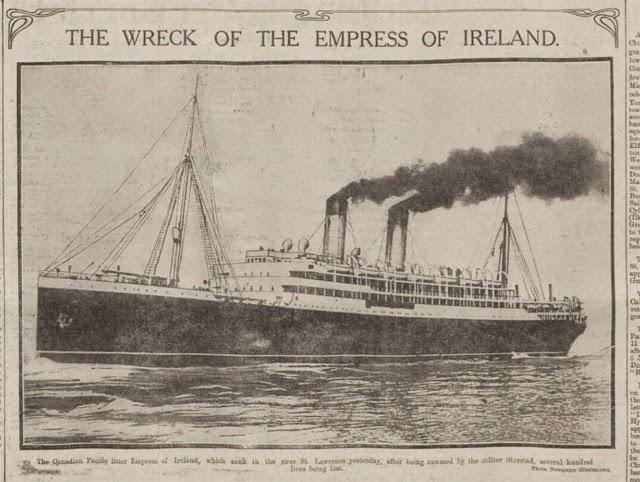
Empress of Ireland: Survivors Experiences

THE CANADIAN DISASTER.

ARRIVAL OF SURVIVORS.

SCENES AT GLASGOW.

Desperate Fights for Life

Glasgow, Tuesday. -- The Allan liner Corsican berthed in the Princes Dock, Glasgow, at four o'clock this morning, bringing the surviving members of the crew of the ill-fated Empress of Ireland, and also a number of her passengers. Arrangements had been made for boarding the ship off Greenock at eleven o'clock last night, but an official intimation that she was likely to appear off the Tail of the Bank at least two hours earlier caused many persons, including a strong force of newspaper representatives, to hasten down to Greenock. They were grievously disappointed, as it was half an hour after midnight before the Corsican hove in sight, and there was a scramble to board her from a tug. Her captain feared to lose the tide, and so the steamer merely slowed down for an instant, and then passed on to her destination.


The passengers most sought after were in bed, and the sailors who had been saved from the Empress of Ireland were not to be approached until after berthing, but between midnight and 4 a.m. the representatives of the Board of Trade had appealed, and after the Corsican had cast off her tugs inquisitive persons were informed that an official inquiry was proceeding. A rumour had spread at Greenock that the survivors amongst the seamen were to be represented by one of their number, who would make a statement for publication, but it transpired on the authority of an official that no such arrangement had been contemplated. A pledge was also exacted that no attempt should be made to approach the passengers until a certain time had elapsed.

A PATHETIC INCIDENT. 

One pathetic incident marked the arrival of the Corsican. A Mr. Newton, of Southport, travelled to Greenock with a sister-in-law, who had a brother, Mr. J. W. Furness, first violinist on the wrecked vessel. This lady, Miss Furness, went alongside on the tug, but was not permitted to board the Corsican. In the list of saved there had appeared the name of Furness, but with different initials from those of her brother, and the relatives had journeyed down from Lancashire in the hope that the initials had been wrongly printed, and that the musician was aboard the Allan liner now nearing port. Miss Furness remained on the deck of the tug until it had piloted the Corsican into dock, and Mr. Newton signalled from the steamer that their hopes WW* but ill-founded. Miss Furness, realising the worst had happened, became prostrate with grief, and received many expressions of sympathy.

Mr. Furness was formerly a ship's bandmaster, but coming home from a trip and finding his aged mother at the point of death he elected not to sail on the outward voyage. His ship left the United Kingdom without him, and his agents then offered him the position of first violinist on the Empress of Ireland. This he accepted. His father, now old and infirm, was in an agony of suspense awaiting the news which his daughter and son-in-law had to take him from Glasgow as to the result of their quest.

There was a scene of greet activity on board the Corsican after she had docked, and much of this was due to the distribution by Allan line officials of a complete kit to the rescued seamen and passengers, the latter of whom were all third-class.

AN AUSTRIAN'S NARRATIVE.

Mr. A. Heller, a passenger of Austrian Extraction, but a naturalised American citizen, recently living in Toronto, in the course of a conversation aboard the Corsican, stated that he was in the habit of making monthly journeys to this country. "I was," he said, "in the steerage of the Empress of Ireland, and there were three others occupying the same cabin. I was sleeping at the moment of the collision with the Storstad, and was awaked by one of my three companions. We all immediately left the cabin to get up the companion-way to the deck, but so great was the list in the ship at that time, and so unsteady was her movement, that I slipped back three times. I was wearing a shirt and pants only. Eventually, and with some difficulty, I managed to get to the deck when the ship was heeling over, and it was next to impossible for me to keep my feet. I went towards the lifeboats, but there was scarcely time to swing them free of the davits owing to the rapidity with which the ship was settling down. The man who awoke me was, I regret to say, among the drowned. There were a good many people out of their berths, including women and children.

"I slid down pretty nearly to the water's edge and then dived. I am a good swimmer, and I was anxious to get away from the ship, as one of her funnels was apparently hanging over. At the instant of my throwing myself into the water women were screaming and clinging to all sorts of floating gear. Some passengers were rolling into the sea, as the decks were getting well-nigh perpendicular. I had just got clear when the Empress of Ireland disappeared. Everything then became quiet. It was after I had been keeping afloat for twenty-five minutes that I was picked up by a boat. There were twenty-six members of the crew in that boat, and there was room for eight or ten more occupants."

THE SURVIVORS.

The British survivors are --

Mr. S. C. Furness and Mr. G. Dransfield (Liverpool).
Mr. W. G. Bevan (Swansea).
Mr. C. Bristow and Mr. C. H. Bristow (Leeds).
Mr. Martin Gill (Belfast).
Mr. G. C. Kirtley (West Hartlepool).

With the exception of Mrs. Kirkley, all the Britishers declined to make statements. Mrs. Kirkley told a short but graphic story of how she escaped. The lady was in charge of a nurse on the Corsican, but she had sufficiently recovered from her terrible shock to be able to relate her thrilling experience. Mrs. Kirkley is a good swimmer, and to that she owes the fact of the almost miraculous circumstance of being alive to-day.

LADY'S FIGHT FOR LIFE.

She stated -- "As soon as I realised the danger I ran from my cabin to the deck. It was a matter of no little difficulty, too, as the ship almost immediately lurching upon its side, I could not get at a boat, and saw the only chance was to dive and trust to my swimming capacity and luck. When the rail of the ship was near the water's edge I dived, and went no considerable distance under. Striking upwards I got to the surface, when I saw several people around me floundering about and moaning and shrieking. Then a man who was in almost a state of collapse caught hold of me when I was approaching a boat. I was by this time fast becoming exhausted, especially as the man clung to me like grim death, and try as I would I could not get him to release his grip.

"With a supreme effort I managed to clutch the boat after having been in the water a few minutes; then I threw one of my legs over the side of the boat rail, but the man still clung to me. To save myself, for it was my only possible chance, I shook the man off. With a cry he sank, and that was the last I saw of him. I could do no other. My strength was fast going, and had I not acted as I did I should have dropped back into the sea and been lost." Mrs. Kirtley is a lady of about thirty-five and of fairly robust build.

The arrival of the Corsican was expected, and even at that early hour many people assembled outside the shed of the dock where she was berthed in the hope of getting a glimpse of the survivors. The sailors on the river cheered.

The stewardess of the Empress told how, when she heard the crash, she made for the upturned side of the ship, slipped down the deck, and dived just as the vessel was about to sink. "I can only remember," she added, "someone catching hold of me, and I woke up safe on board the Storstad.

Soon after reaching Glasgow the Continental survivors entrained for Grimsby en route to Hamburg, the Empress passengers for their respective destinations, and the majority of the crew for Liverpool.

-- -- -- -- -- -- -- -- -- -- -- -- --

SURVIVORS AT LIVERPOOL


REJOICING AND SORROW!

The Allan liner Alsatian arrived at Liverpool yesterday with a large number of survivors from the Empress of Ireland. Among them were six first-class passengers, six second-class, and thirty-five steerage, the latter nearly all foreigners. There were also on board 106 stewards, fifteen deck hands, and five members of the engine-room staff of the ill-fated liner.

The Alsatian also brought home nine bodies of victims -- namely, Chief Officer Steede, Storekeeper Wildman, Miss Biddlel, stewardess, and six foreigners.

A large number of relatives and friends of the members of the crew proceeded down the Mersey on a tender to meet the liner. There were loud cheers as the survivors were recognised, and when they landed there were many affecting scenes.

DRAMATIC SCENES.

The survivors aboard the Alsatian presented a curious spectacle, and some of their relatives experienced difficulty in recognising them. They were attired in all kinds of suits, and many of then seemed to have had complete new rig-outs. When the survivors met their relatives in the waiting-room at the landing stage the joy of reunion in many cases was almost hysterical. The woman flung themselves sobbing into their husband's arms, and the children cried with delight as they held their fathers by the hand.

One pale-faced woman was almost smothered with kisses by her husband. She had given birth to a baby boy fourteen days before the disaster. At first her husband was reported drowned, and the woman had almost given up life and hope when she received a cablegram announcing that he was saved.

CLIMB THROUGH PORTHOLE.

Tipperary Man's Narrative

Mr J. D. Langley, of Tipperary, a second class passenger aboard the Empress of Ireland, told a graphic story on landing. He said that on reaching the doors to that deck he found they were closed. Some people who were trying to get out declared they were jammed. He volunteered to try and clamber through a port hole to open the door, but stuck when half-way through. He, however, managed to wriggle through, and tried to open the door. It would not budge, and he told the people inside he must leave them. He scrambled on the railings where there was a member of the crew with a life belt on.

When the ship sank they went down with her, but came up to the surface within a few feet of each other. They kept afloat about ten minutes witnessing embarrassing scenes, but eventually came alongside an upturned lifeboat. They were pulled on that by some of those already aboard, and sat shivering there for two hours before rescued by a pilot boat.

Between them they pulled fifteen or twenty people out of the water, and watched two men with lifebelts on drown, being unable to reach them. It was hideous hearing people who were drowning call for help. He saw no women in the water, and concluded that they had been unable to leave the ship.

"WHERE'S MUVVER."

Mr. J. J. Lennon, of Winnipeg, said he saw a little girl in night attire lying unconscious in the water. He managed to pull her into a collapsible boat. She soon came to her senses, and asked "Where's Muvver." He told the child her mother would be all right to comfort her, and they took bar to Rimouski.

OTHER STORIES OF ESCAPE

Percy Gee, a steward, said he just managed to scramble out of the boat which had rescued him when one of the lifeboats fell on it, killing and injuring several people, and smashing the boat to pieces. He was picked up by a collapsible boat after being in the water about half an hour.

Robert Crellin, of Cleator, who rescued Florrie Barber, a little girl, whose mother and sister were lost, said he fetched her from the cabin, and when the ship was sinking plunged into the water with her. He swam toward a lifeboat through bitterly cold water, which was crowded with dead and dying people. They were taken into a boat which contained over sixty people. The most terrible part of the disaster was the sight of hundreds of people struggling in the water while the boats near them were too full to take any more aboard. The water was black with heads bobbing up and down, and the cries were pitiful. He had left the child at Quebec, where there were several wealthy people desirous of adopting children who lost their parents in the disaster.

Mrs. Fanny Evinson, of Leeds, who lost her husband and baby, said in the companion way the people were fighting for their lives; bit the foreigners were the worst, as they tried to force their way on deck carrying luggage. They were all blown into the water by the explosion or rush of air, and on coming to the surface she could see nothing but the heads of people crying for mercy. She managed to keep herself afloat, although unable to swim, until she clutched the sides of the boat. Next day she learned that her husband and baby were drowned.

-- -- -- -- -- -- -- -- -- -- -- -- --

BELFAST SURVIVOR'S EXPERIENCES.


A THRILLING STORY.

Mr. Martin Gill, a Belfast man, who is one of the survivors of the Empress of Ireland disaster, has arrived in Ireland from Glasgow, to where he travelled from Canada by the Allan liner Corsican. In the course of an interview he said that as the ill-fated liner dropped down the river he retired to his cabin, and in a short time was asleep. The next moment of consciousness came to him as the collision took place. "I awoke," he said, "at the sound of a mighty crash which was followed immediately by an indescribable sound of grinding and smashing. For m moment I was half-stunned with the noise and the concussion, but soon realised that some catastrophe had befallen the ship. I suppose the memory of the Titanic's fate suggested a collision with an iceberg, but that was the first thought that sprang to his mind. Two minutes later I was in the midst of some people scrambling for the deck. I didn't dress; in fact all the passengers I saw were in their night-clothes. The awful sound of water rushing into the ship was enough to upset the coolest of us, and I, for one, did not take time to lift anything. I had 1,500 dollars, and all my worldly possessions in the cabin, but when life depends on moving quickly, one does not think of such things. On deck I saw that another steamer had collided with the Empress. The bows of the Storstad had bitten 8ft. into the side of ship.

"I didn't wait much longer. Torrents of human beings were streaming out to the decks, and darkness added to the confusion. From the top deck of the ship I dived into the icy water, and, after what seemed an interminable period, I came again to the surface and struck out. I never considered myself a good swimmer, but I found I could swim well when I had to save my life. I swam directly away from the Empress towards the Storstad. There was a fog on the water at the time of the collision, but it suddenly lifted like a veil and I could see both vessels. I had got a hundred yards from the Empress when she foundered. I will never forget the sight as long as I live, and the moans, shrieks, and shouts are still ringing in my ears.

"I was in the water about half an hour, and had almost reached the Storstad," continued Mr. Gill, "when I was picked up by one of her lifeboats. I didn't know a single person on board, although most of the survivors have lost relatives who were traveling with them." Mr. Gill, who was supplied with clothes and passage money by the C.P.R., was asked if he were going back to Canada. "I had intended to go back," he said, "but I have not yet got over the shock of that awful night, and I may decide to remain in Ireland for the future."


This article originally appeared in The Witness 12 June 1914.

image top: Emigrants on the Empress of Ireland

Monday, 9 June 2014

Empress of Ireland - Official Inquiry and Storstad's Defence

CANADIAN CATASTROPHE.

TOLL OF THE DEAD.

WORLD-WIDE SYMPATHY.


THE OFFICIAL INQUIRY.

It is expected that the Court of Inquiry appointed by the Canadian Government to investigate the loss of the Empress of Ireland will be composed of Sir Adolph Routhier, the Hon. Ezekiel M'Leod, and Lord Mersey, the latter being the nominee of the British Board of Trade. The third class survivors have been transferred to the Allan liner Corsican, which is due in Glasgow on Tuesday of next week.

Quebec, Wednesday. -- The Canadian Pacific Railway yesterday evening issued official figures raising the number of fatalities in the Empress of Ireland disaster to 1,024, or fifty-five over the previous figures. The vessel carried 1,476 persons, of whom 452 were saved -- namely, thirty-six first cabin, forty-seven second cabin, and 136 steerage passengers, and 233 officers and crew. Only a few more than 200 bodies have been recovered, of whom 103 have been identified.

IDENTIFICATION PRECAUTIONS

The European manager of the Canadian Pacific Railway in London has received an official cable to the effect that the entire Delamont family of five, belonging to Toronto, who were third class passengers, were saved. The only further identification of the bodies advised has been that of May M. White. In order to assist in the proper identification by relatives at a future period precaution is being taken to have the bodies photographed, each with an indication number, which will also be used for the grave.

THE STORSTAD'S DEFENCE

Amazing Statements.

Montreal, Monday. -- The following statement is made by Mr. J. W. Griffin, of New York, representing the owners of the Storstad --

Conversations with several officers and members of the crew of the Storstad all bear out the story that the Storstad was going full speed astern when the collision occurred. One of the most important statements made was by the third engineer of the Storstad, who refused to give his name. He said that he was on duty in the engine-room when the collision took place. He was asked, "How long before you struck was the signal given to go astern?" He replied, "It is impossible to say definitely, but it was something like a minute; I should say a little longer than a minute."

"There is no doubt about your having got the signal to go full speed astern?" "I am certain the engines were going full speed astern when the collision took place."

The third engineer's statement was borne out by the second engineer, who was not on duty at the time of the accident. He asserted that at no time for several hours before the collision had the Storstad gone at greater speed than ten miles an hour. Thick fog was encountered at intervals. The shock of the impact was not very noticeable. I did notice, however," he said, "that the engines had been reversed. We were going full speed astern about one minute before the shock."

When asked regarding the evidence given at the inquest that had the Storstad not backed away the Empress of Ireland might have been kept afloat long enough to allow most of the lifeboats to be lowered, the second engineer stated that he did not think that would have been the case. The blow struck was a glancing one, and even had the Storstad gone ahead instead of astern she would have glanced off, and both steamers would have been separated just as quickly as they were in fact.

A ZIG-ZAG COURSE.

Captain Holtung, of the Norwegian collier Alden, has told a highly-responsible official what his second officer and pilot saw when they passed the Empress of Ireland some thirty sea miles from where the collision occurred only a short time before the disaster. According to what the official told the "Montreal Star" this is what took place --

The Alden, chartered by the Dominion Coal Company, was on her way up the St. Lawrence, only thirty miles from Father Point, when the Empress of Ireland was sighted steaming towards them. Both the pilot and second officer were on duty on the bridge of the Alden, and are said to be willing to swear to the following --

The Empress of Ireland was steaming down the St. Lawrence when they met her. She was approaching the collier in such an erratic manner that both pilot and second officer became greatly concerned. So erratic, they are said to have declared, was the course that at times her green light could be seen, at other times her red lantern would show. The course of the Empress of Ireland is described as zig-zag.

Another officer of the Storstad said he was awakened in his bunk by the clanging of the bells in the engine-room. Hastily going on deck, he noticed the ship going astern. Almost immediately came the collision. Quickly he helped to lower a boat and started to pick up passengers. There was no trouble in getting a load full. Altogether sixty were saved in the first trip, So heavily was the boat loaded that she all but sank on her return to the Storstad. As far as this officer could tell, four other lifeboats were lowered from the Storstad. Most of those saved in the first trips belonged to the crew of the Empress of Ireland. He could not account for this beyond supposing that they were better able to endure the shock and exposure. Asked if he noticed the siren of the Empress of Ireland sounding, he replied that he heard nothing, but would not say that the Empress of Ireland did not sound her horn. -- "Times" Telegram.

MRS. ANDERSEN'S STORY.

Mrs. Andersen, wife of the captain of the Storstad, told her story on Monday, says Reuter's Montreal correspondent. She apologised for receiving the newspaper representative in a blue cotton dress, explaining that she had, given all her other clothes to survivors. She said the captain was called from his bed on Friday morning by the mate because it was foggy. Her husband asked her to follow him on deck. While she was dressing the collision took place. She ran to the bridge, where Captain Andersen was. Everything was dark and quiet, and there was no excitement among the crew. She kept cool, and stayed on the bridge. She asked Captain Anderson whether the Storstadt was going to sink. "I think do," he replied. She could not cry, although she felt like it.

Captain Andersen told her he was trying to keep the Storstadt in the hole she had made, and if the liner had not been speeding they would have stopped altogether, for a time at least. In a few minutes she asked again whether the Storstadt was sinking. "I can't tell yet," the Captain replied.

THE SHIVERING SURVIVORS.

"I think it was five minutes later," continued Mrs. Andersen. "that I heard screams and cries. I shouted to my husband, 'Oh! They are calling.' At first it seemed as if the cries ware coming from the shore. The captain gave orders to go in that direction, and proceeded, very slowly. Everywhere around I could hear screams. My husband gave orders to send out all the lifeboats. That could not have been ten minutes after the collision. The first woman to come aboard was a Salvation Army lass, clad only in her nightdress. When she was brought to the cabin she ran to me, putting her arms round my neck, and said, 'God bless you, my angel. If you had not been here, we should have gone to the bottom.'"

After the rescued had been taken on board Mrs. Anderson went among them with stimulants. All the cabins were packed with shivering survivors scantily clad. Many sought the engine-room for heat, and were so number by the icy water that they leaned against the cylinders of the engine till the flesh blistered.

SURVIVORS COMING HOME.

The Canadian Pacific Railway Company's London office is informed by cablegram from Montreal that sixty-one rescued third class passengers were transferred to the steamship Corsican, which sailed on Monday for Glasgow together with seventy-four members of the crew of the Empress of Ireland. An official of the company will meet the survivors on their arrival in Glasgow, and provide them with necessary clothing and sufficient funds to carry them to their destinations.

Among the sixty-one rescued passengers referred to are Mrs. E. Kirtley, of West Hartlepool; S. C. Furness, W. G. Bevan, and George Dransfield, of Liverpool; Martin Gill, of Belfast; and C. Bristow and C. H. Bristow, of Leeds. The names of the crew coming by the Corsican have not yet been received.

YOUNG IRISH VICTIM.

Mr. Murtagh, teacher, Trim School, received the following telegram on Monday -- "Matthew Murtagh, steward, saved. Deeply regret no report W. Murtagh, bellboy. -- Canadian Pacific." William Murtagh was a lad aged 17, who was with the company about two years. His uncle, Matthew, a saloon steward, took him with him a few years ago, with the view of giving him an opening in life, the lad's father, who was teacher in Meath, having died.

TRAGIC FATE OF YOUNG ORPHANS.

One od the most pathetic stories arising out of the Empress of Ireland disaster is that associated with the loss of the four young girls names Farr -- Kathleen, aged eight; Nancy, six; Dorothy, five; and Bessie, three. They belonged to a family of eight -- all girls. Their father was a farmer in the neighbourhood of Bostin, Lincolnshire, and he went out to Canada, where he was joined by his wife and children two years ago. He died soon after, and the mother succumbed to typhoid fever last November. The four girs were being brought to England by their uncle, Mr. Harold Farr, at Henley-on-Thames.

FUNERAL ARRANGEMENTS.

It has been decided, says a Central News message, that the bodies of the unidentified victims will be embalmed and placed in vaults at the Quebec cemeteries, with a view to possible future identification and removal for burial elsewhere. The funerals, of nine members of the crew, whose bodies have been identified, will take place to-day.

Acting on instructions from a relative in England, says Reuter, the C.P.R. Company will bury tho body of Sir Henry Seton-Karr in Quebec.

TRIBUTE TO THE DEAD.

The passengers and crew of the White Star liner Megantic, which arrived at Montreal yesterday morning, joined on Sunday evening in an impressive service held on the spot where Empress of Ireland sank. Captain David stopped his ship near the buoy which marks the site of the wreck, and mustered the crew and the passengers on the deck, where with bared heads they sang this hymn, "Abide with me," the ship's orchestra accompanying the singing. Many of those who took part in the touching tribute to the dead were visibly affected.

RELIEF FUNDS.

ROYAL DONATIONS.

The Lord Mayor of London has received the following Royal messages:--

Privy Purse Office,
Buckingham Palace, June 1st, 1914.
My Lord, -- I have it in command from the King to inform your lordship that his Majesty subscribes the sum of £500 to the fund your lordship is raising for the help of those stricken by the loss of the Empress of Ireland. For them in their overwhelming sorrow the King feels most deeply. -- I remain, &c.,
WM. CARINGTON.

Buckingham Palace, June 1st, 1914.
My Lord Mayor, -- I have received the Queen's commands to transmit to your lordship a cheque for £250 as a contribution from her Majesty to the Mansion House Fund which is being raised for the widows, orphans, and dependent relatives of the crew and passengers who lost their lives in the recent appalling disaster to the Empress of Ireland. The Queen deeply sympathises with the poor bereaved relates in their overwhelming sorrow.
E. W. WALLINGTON.

Marlborough House, June 1st, 1914.
Dear Lord Mayor, -- I am desired by Queen Alexandra to send you a cheque for £200 as a donation towards the fund which her Majesty is glad to see you have opened at the Mansion House for the relief of the poor sufferers from the most appalling disaster to the Empiress of Ireland. -- I remain, &c.,
D. M. PROBYN.

The Prince of Wales has sent a donation of £250.

The Canadian Pacific Railway Company have subscribed £5,000 to the Mansion House Empress of Ireland Fund, and Sir Thomas Shaughnessy, president of the company, £500. The company and Sir Thomas have sent similar sums to the Lord Mayor of Liverpool's Fund.

SYMPATHY OF BELFAST CORPORATION.

At Tuesday's meeting of the Belfast Corporation, the Lord Mayor (Councillor Crawford M'Cullagh, J.P.) said that before commencing the regular business of the Council he thought it right that the Corporation should pass a resolution of sympathy with all those who had been so tragically bereft of friends and loved ones by the loss of the Canadian Pacific Company's steamship Empress of Ireland, in the estuary of the St. Lawrence, on Friday, 29th May. They were not in a position to know the exact details, all of which would, no doubt, be forthcoming at the investigation which must be held, and if they were it was not for them as a Corporation to criticise. They only knew that, unfortunately, many valuable lives had been lost, and no matter what rank, those people belonged to, high or low, their friends and relatives had been suddenly and unexpectedly bereaved, and they deeply and sincerely sympathised with them one and all. That the tragic circumstances called forth many examples of all that was best in human nature was only what they expected when a catastrophe occurred to a British ship with British crew and passengers; nevertheless, it made them glow with pride to hear again hear how Britons die. He begged to move -- "That the deep and heartfelt sympathy of the Council be and is hereby tendered to all who have lost their loved ones by the disaster that befell the Empress of Ireland on the 29th May, 1914."

The resolution was passed in silence.

EMPRESS OF IRELAND'S SUBSTITUTE.

Mr. G. M'L. Brown, European manager of the Canadian Pacific Railway, states that the company has completed arrangements by which the Allan Line triple-screw turbine steamer Virginian will take the sailings which had been arranged for the Empress of Ireland during the summer season. The Virginian will make her first sailing from Liverpool to Quebec and Montreal on Friday, June 12, and regularly thereafter.


This article originally appeared in The Witness 5 June 1914.

image: The Empress of Ireland


Friday, 30 May 2014

Empress of Ireland Disaster - Thrilling Experiences

Salvation Army Officer's Account.

Rimouski, Friday. -- Thrilling experiences have been related by Salvation survivors of the Empress of Ireland disaster. Captain Wilson of Toronto, shared a cabin with Adjutant Green and Bandsman Johnston, who were saved, and Captain Dodd, of Toronto, who perished. Captain Wilson was awakened by the collision, but thought so little of the matter that he did not get up at first. Finding the ship listing, however, he rose with the others and went out, but owing to the slant of the decks they had difficulty in climbing to the rail. At last after they had noticed the odour of gas there came the roar of a terrible explosion, and Captain Wilson found himself thrown half stunned against the rail, which he grasped. He climbed over and found himself sitting with hundreds of other passengers on the ship's side, which as the vessel settled became almost horizontal.

A few moments later he was in the swirling water. He seized a piece of wreckage as he felt himself being sucked down, and he was under water for a seemingly interminable period. On coming to the surface he twice lost and regained hold of wreckage. The water was intensely cold but Captain Wilson managed to hold on until he was picked up by the second lifeboat which passed, the first being already overcrowded. He was given an oar, but was too benumbed to hold it, and be fainted. The next thing he remembered was being hauled into the Storstadt by a rope.

"When I was trying to reach the rail," related Captain Wilson, "a woman handed her five-year-old girl. I tried to lift the child so that Ensign Pugmire, who was clinging to the rail above me, could grasp it, but he could not reach it. I saw it was hopeless, so just before the plunge I handed the child back to its mother. I did not see them again."

Major Attwell, of Toronto, saved his wife and himself in one of the steamer's useless lifeboats. He found a life belt, and fastened it to his wife. He himself secured an air cushion, and with these the couple kept afloat, although they were sucked under three times when the ship foundered.

Captain Townsend, the officer in charge of the Salvation Army work in Quebec- City, will arrive here to-night to take charge of the bodies of the army victims. His wife was to have sailed by the Empress of Ireland, but was too ill to leave Quebec.


SALVATION ARMY OFFICER RESCUED.


News was received at the Salvation Army headquarters, London, on Saturday, that Capt. Pugmire is among the rescued. This raises the total number of Salvationists rescued to 22, out of about 160 on board, Commissioner M'Kie left London this morning for Liverpool, where he will join the Aquitania. He is proceeding to Canada to take up temporary command there. "We shall all bow our heads in subdued sorrow, but the Salvation Army must march on," said Brigadier Perry to-day.


This article originally appeared in The Witness 2 June 1914.

image: British Newspaper Archive

Empress of Ireland Disaster - The Survivors

THE SURVIVORS.


OFFICIAL LISTS OF PASSENGERS AND CREW


Several lists of the rescued passengers have been issued. The names are as follow --

FIRST CLASS.
F. E. Abbott (Toronto). Lionel Kent (Montreal).
J. R. Abercrombie (Vancouver). Miss Grace Kohl (Montreal).
Mr. and Mrs. P. J. Adie (Birmingham). Miss A. H. Lee.
A. J. Burrows (Nottingham). C. B. Lyon (Vancouver).
R. A. Cunningham(Winnipeg). C. Malloch.
D. A. Darling (London). Mrs. A. E. Mullins (London).
W. Fenton (Manchester). Mrs. H. R. O'Hara and daughter (Toronto).
Miss Doris Gaunt (Birmingham). Mrs. W. E. Patton (Sherbrooke).
P. Godson (Kingston). E. Seybold (Ottawa).
L, A. Gosselin (Montreal). Miss T. Townsend (New Zealand).
G. W. S. Henderson (Montreal). Rev. J. Wallett (London).
Miss J. T. Blyth. C. R. Clark (Detroit).
C. Gallagher (Montreal). Miss H. Taylor (Montreal).
L. A. Hyamson (London). Mr. and Mrs. Harwood Cash (Nottingham).

SECOND AND THIRD CLASS.
K. Abanok. K. Joyo.
P. H. Archer. Y. Kamimicky.
J. Anderson. James Johnston.
A. M. Arikkalam. A. Klamont.
Major Atwell. Adam Koklickach.
Mrs. Atwell. A. Kalebutala.
Miss Ethel Bachi. M. Kutchen.
Miss Edith Boch. J. Krutin.
Bokey P. Bartosch. M. Koczak.
M. Beoocries. Mrs. Kirtley.
Mr. and Mrs. J. H. Black --. Koschriss.
Miss D. F. Blythe. A. Kranchisky.
Elliss Boris. Miss F. Kruse.
T. Bonar Ryak Alfred Keith.
A. Bradley. Rowel Lea.
Mr. and Mrs. W. R. Brooks. H. Lawler.
J. K. Lenaly. Miss A. Lee.
A. Brown. Miss Martha Luren Linquist.
F. Brooks. Laurence L. Barbour.
J. Burns. J. J. Lennon.
G. Buckass. G. Maguire.
E. Byrne. J. Maguire.
B. Brict. Miss F. Maloch.
J. Braga. D. McAmmond.
Eric Burainon. W. H. Measures.
Alice Bales. F. M. Melson.
B. Chamboi. B. Minanch.
Charles Clark. Major Morris
--- Conspanion. S. Missila.
Miss E. Court. T. Munteau.
Jaz. Connor (colour). V. Moore.
J. R. Crombie. H. Mose
R. W. Crellin. --- Musychuk.
Mrs. G. C. Cook. John Murphy.
J. Fergus-Duncan (London). H. Murninnon.
Jack Rubenstein. M. Moseszuk.
W. Davies. Kenneth M'Intyre.
Gordon Davidson. P. Noenickky.
Dennis P. Darling. F. Calender.
D. Datonkist. Julen Patrick.
J. Evanson. Geo. Pott.
S. R. Delamount. W. Paschkowdis(?).
J. R. Delamount. E. Pugmire.
J. F. Elias. A. Pykara.
E. L. Erickson. G. Parkinson.
J. Erzinger. H. Peterson.
A. B. Evans. Mrs. Peterson.
Mr. and Mrs. H. Freman Wm. Quinn.
Buma Fano. Carl Randle.
F. Ferguson. K. Rautain.
A. Ferugay. A. Ranyon.
Tercy Flynn Flack. S. Robekjchenko.
A. Ford. T. Romanechi.--- Shodlak.
J. Fowler. A. Rainyecna.
W. Foss. John Salo.
Dr. James Grant. P. Sanderson.
--- Graywhit. M. Sanconia.
J. J. Gragowitz. Albert Smith.
Mr. and Mrs. Green. A. B. Spooner.
T. and Mrs. Greenway. W. Schakalida.
Martin Gill. A B. Smart.
Ernest H. Green. A. Sobiye.
A. Gray. M. S. Warnstone.
Herbert Greenaway. B. Sosison.
Y. Kanimiski. J. Scotni.
A. Hiller. B. Sundor.
Mr. and Mrs. G. Hedgecock. C. H. Smith.
Dr. Hunt. Miss Schongutt.
U. Holkis. Alan Taylor.
Grace Hannagan. Miss Wilmott.
Grace Hannagan. C. B. Wembauch.
D. Johnson (Fredricton, N.B.) Capt. Wilson, S.A.

MEMBERS OF THE CREW.
The following are the crew saved, so far as can be ascertained up to 7-30 on Saturday evening --

SAILORS.
Bruin, T. Hartford, N.
Brown, W. Hudson, J.
Clarke, J. Jones, D. H.
Downey, T. Jeffries, J. F.
Donnelley, E. Lang. B.
Dennis, T. Moran, J.
Diseley, J. M'Coy, J
Evans, A. M'Ewab, J.
Evans, J. M'Dougall, D.
Fitzpatrick, J. M'Guire, J.
Fawcett, W. Price, J. H.
Fitzgerald, H. Sims, J.
Gratwick, T.

FIREMEN AND TRIMMERS.
Bailey, G. M'Ginniss, R.
Brown, P. Murphy, W.
Campbell, M. Mitchell, J.
Clarke, J. J. Neal, Henry.
Campbell, J. Quinn, J.
Cottle, Sam. Rowlands, T.
Duffy, J. Rockford, M.
Davies, P. Rochford, M.
Davis, J. Rice, E.
Dolan, P. Ryan, T.
Daves, J. Sheridan, P.
Donaldson, J. Smythe, J.
Foster, E. Stephen, J.
Gray, J. Smith, J.
Hayes, E. Toole, J.
Jackson, E. E. Toole, P.
Keegan, J. Whitty, J.
King J. Wilson, J.
M'Ready, T. White, Henry.
M'Ewan, J.

LEADING FIREMEN.
Cassey, J. Murphy, P.
Hood, T. M'Case, J.
Hutchinson, A. Neill, H. D.
Malone, P. or J. Hitty, J.
M'Ginnis, J.

STEWARDS.
Absolon, V. Grieves, G.
Brown, J. Gibson, J.
Challis, M. Green, F.
Cure, A. Griffiths, O.
Clague, R. Hughes, W. R.
Cooke, T. Hughes, W. L.
Campa, W. Hird, W.
Dixon. Hebret, W.
Dumbell, T. Harrison, F.
Donegan, J. Haish, S.
Dixon, A. H. Hayes, J. A.
Flimo, R. Jones, C.
Fireday, A. Jones, O.
Foyle, R. R. M'William.
Grey, A. Metcalf, H.
Gill, H. Myers, J.
Gregory, F. Metcalf, T.
M'Sherry, J. Smith, J.
Owen, W. S. Smith, A. E.
Price, T. Shannon, F. J.
Prouse, J. W. Smith, H. K.
Pritchard, O. Williams, A. C.
Parry, D. Williams, T.
Pritchard, J. Williams, R.
Pitts, W. H. Williams, Jos.
Rowan, W. Gaade, A. W.
Roberts, W. Hollies, H. (stewardess).
Robertson, J.

ENGINEERS.
Brennan, R. H. M'Ewan, J.
Hampton, W. O'Donovan, G.
Johnston. J. A. B. Samson. W.
Liddell, R. R. Smith, A. E.
Moonie, G. Swan, J. H.
M'Donald, C. K. White, J. B.

GREASERS.
Duggan, P. O'Donnell, D.
Darcy, F. Reardon, D.
Holding, S. Summers, J.
Megson, J. Stephens, J.
M'Adam. W. Sheridan, R.
Mahar, T. Williams, W.
Nelson, C.

COOKS AND BAKERS.
Bratithwaite, J. Mathhewa, J. L.
Bishop, T. Rohr, A. S.
Cunningham, J. Sharkey, N.
(-?-)don, H. Shaw, H.
(-?-)tt, A Smith, T. J.
[-?-], P. Turner, J.
[-?-],A. Ventry, J.
Lee, S. Williams, D.
Lewis, J.

SCULLERY AND PANTRY MEN.
Cope, J. Prince, W.
Copplin, G. Thomson, A.
M'Aleavy, P. Wynn, T
Owen, R.

STOREKEEPER.
Burns, C.

QUARTERMASTERS.
Galway, J. Murphy, J.

BOATSWAINS.
Sprague, T. Bradley, A. C.

MARCONI.
Bamford, C. Fergerson, J.

PRINTER.
Duggan, J.

BUTCHERS.
Dawson, A. M'Donnell, H. J.
Knight, R. Paterson, I.

ELECTRICIANS.
Duckworth, W. B. Grant, J.

BAR-KEEPER.
Davis, J.

SECOND OFFICER.
Fife, O.

SURGEON.
Grant, J. F.

BARBER.
Glassberg, R.

ASSISTANT PURSERS.
Hayes, E. Wakeford, C.

BUGLER.
Hobson, S.

FIRST OFFICER.
Jones, E. J.

CAPTAIN
Kendall, H. G. (slightly injured).

BOOTS.
Marl, W. Powell, L.

BELLBOY.
Spencer, C.

MASTER-AT-ARMS.
R. Saunders.

The following deserted at Quebec -- Cooney, J.; Caldwell, J.; Doolan, J.; Mountain, T.; Neil, C. -- total, 211.

The following engineers, ex-Asia, were signed on for passage home -- James Rankin-Scott, W. Albert Smith, Bryan H. Lockhart, J. Homes Scotand -- all reported lost.

The 1914 funeral service for those who drowned on The Empress of Ireland.

MESSAGE FROM MONTREAL.

BODIES IDENTIFIED.

Maginnis, A. G., director of Mappin & Webb, Ltd., London.
Holt, K. E. Toronto.
Goldthorpe, Chas., of Bradford.
Crathern, Miss, Montreal.
Gallagher, Mrs., Winnipeg.
Barlow, Mrs. A. E., Montreal.
Seybold, Mrs., Ottawa.
Bow, Adjutant and Mrs. De, Toronto.
Hannagan, E., Toronto.
Morris, Mrs., Toronto.
Green, Mrs., Toronto.
Findlay, Major, Toronto.
Lavis, Mrs., Toronto.
Potter, Brigadier,Toronto.
Bristow, Mrs., Westminster.
Paavetila and son.
Potter, Brigadier, Montreal.
Wilkes, Toronto.
Major Nettie Lymcoe, Manitoba.
Georgi Zonk and Bladisten Zonk.
Hannan, F. S., Manitoba.
Hunton, Mrs., Salvation Army, Manitoba.
Brooks, Dolly.
Potter, W., Manitoba.
Leonard Palmer, Mrs. W., Toronto.
Archer, Mrs. Hannuanen, E.
Kivolsky, Ivan.
Steele, R., chief officer
Wildman, J., storekeeper.
Braine, E., bedroom steward.
Thompson, G. J., plumber.
Peterson, V., carpenter.
Perry, H., assistant steward.
Pearson, Mrs. S. J., stewardess.
M'Grath, J., assistant steward.
Parkinson, second-class steward.
Rees, Mrs., Commissioner.
Maidment, Colonel.
Potter, Brigadier.
Findlay, Major.
Simcoe, Mrs., Major.
Harry Green, Adjt., and daughter.
Hannagan, Adjutant, and Mrs.
Guido Whatmore, Captain and Mrs.
Morris, Mrs. Staff Captain.

Montreal, Saturday Morning:-- The following is a list of the first class passengers saved -- F. E. Abbot, Toronto; Mr. and Mrs. Percy Adie, Birmingham, England; John Atkinson, A. J. Burrows, Nottingham; R. A. Cunningham, Winnipeg; W. Fenton, Manchester; -- Fallagher; Miss Doris Gaunt, Birmingham; L. A. Gosselin, Montreal; G. W. S. Henderson, Montreal; L. A. Hyamson, London; Lionel Kent, Montreal; Miss Grace Kohl, Montreal; C. B. Lyon, Vancouver; Mrs. O'Hara and daughter, Toronto; E. Seybold, Ottawa; Mrs. W. E. Patton, Sherbrooke; Mrs. A. A. Mullen, London.

The second and third class passengers saved were -- A. Benek, K. Archer, P. H. Anderson, J. Arikkalla,, A. M. Bachi, Miss Ethel Beck, Misa Edith Bartsih, K. Boskey, P. Baccerize, M. Black, Mr. and Mrs. J. H. Blyth, Miss B. P. Boris, Eliss Bomaryak, T. Bardley, A. Brooks, Mr. and Mrs. W. R. Brown, A. Burns, John Buckas, G. Byrne, E. Bract, V. Braga, W. Duraimen, Eric Botha Chamber, E. Clark, Chas. Conspanein Court, Miss E. Cannor, James Colore. D. Crombie, J. R. Davies, W. Davison, -- Gordon, -- Darling, -- Dennis, P. Datoukist, D. Lea,  -- Lowell, -- Lawler, H. Lee, Miss A. Lenaly, J. K. Lias, L. Linquist, Miss Martha Luren Maguire, E. Maguire, J. Maloch, Miss F. M'Cammond, D. Measure, W. H. Melson, F. M. Minanch, B. Missila, S. Munteau, T. Moore, V. Mose, H. Muzychuk, Murphy, John Murninaen, M. Moseszuk, M. Nernickky, P. Oslender, F. Patrick, Julien Pott, George Paschkowdis, W. Pugmire, E. Pykara, A. Quinn, Wm. Evanson, J. Jackson, E. L. Erzinger, J. Evans, A. B. Ferrigay, L. A. Fanobuma, Ferguson, F. Glack, Terey, Flynn, Ford, A. Fowler, J. Foss, W. Grant, Dr. James S. Graywhitz, J. Green, Mrs. Greenaway, T. Gill, Martin, Hanalaino, D. Hilweer, A. Hunt, Dr. Holkis, W. Joil, K. Kamnishi, Y. Klamont, A. Koklinkach, Adam Kaloyutala, Kutchem, M. Kritin, J. Keozak, M. Kairkhley, Mrs. Koschriss Krahchenky, A. Kruco, Miss F. Rubenstein, Jack Randle, Carl Kautala, K. Ramyena, A. Rebeljschenke, Silgor Romanechi, T. Salo, John Sanderson, P. Saneomnia, Monro Smith, Albert Spooner, P. Schakalida, W. Schedlok, Smart, A. B. Sobiye, A. Swarnstone, M. Sosison, B. Scotni, J. Sunder, B. Taylor. Allen Thalie, N. Totin, A. Tatti, Y. Tuchesk, M. Talebkka, A. Valinaki, T. Van Lanks, T. Vroilidvalky, Mrs. Hilda Ventre, A. Walker, A. Williams.

 Unloading the coffins of the children from Lady Gray

OFFICIAL LIST.


The following list, the fouHh to be received of second and third class passenger survivors was issued from the offices of the Canadian Pacific Railway to-day -- K. Abanok, F. H. Archer, J. Anderson, A. M. Arikkala, Major Atwell, Mrs. Atwell, Miss Ethel Machi, Miss Edith Boch, B. P. Bartsch, M. Decocriss, Mr. and Mrs. J. H. Black, Miss B. F. Blyth, Eliss Boris, T. Bonarynk, A. Bradley, Mr. and Mrs. W. R. Brooks, A. Brown, J. Burn, C. Buchas, E. Byrne, J. Braga, E. B. Burkinson, Florence L. Barbour, Alice Bales, E. Chamboi, Clark Conspanin, Miss E. Court, J. Connor (coloured), J. R. Crombie, R. W. Crollin, Mrs. G. E. Cook, W. Davies, G. Davidson, D. P. Darling, P. Datonkist, J. Evanson, E. L. Erickson, J. Erzinger, A. B. Evans, Mr. and Mrs. Freeman, Buma Pano, F. Ferguson, A. Ferrigay, Flack, Tercy Flynn, A. Ford, J. Fowler, W. Foss, Dr. John Grant, Graywhit, J. Grazowitz, Miss Green, T. Greenaway and Mrs. Greenaway, Martin Gill, Ernest H. Green, A. Gray, Herbert Greenaway, D. Kanalaino, A. Miller, Dr. Hunt, A. Holkis, Grace Hannagen, K. Joel, Y. Kamanishi, A. Klamont, Adam Kiklickach, A. Kalevutala, M. Kutchen, J. Krutin, M. Koczah, Mrs. Kirthley, Koschriss, A. Kranchisky, Miss F. Kruso, Alfred Keith, Rowell Lea, S. Lawler, Miss A. Lee, J. K. Leneley, L. Liss, Miss Martha Luren, Linquet, J. J. Lennon, G. Maguire, J. Maguire, Miss F. Maloch, D. Moannond, W. H. Measure, F. M. Melson, B. Minanch, S. Missila, T. Munteau, V. Moore, H. Mose, Muskchuk, John Murphy, M. Murninson, Moses Zuk, Kenneth M'Intyre, P. Noenickky, F. Calender, Julien Patrick, George Pott, W. Paschkowdis, E. Pugnire, A. Pykara, C. Parkinson, H. Peterson, Mrs. Peterson, Wm. Quinn, Jack Rubenstein, Carl Randle, K. Rautala, A. Renyona, Silgor Robeljchenko, T. Romanechi, John Salo, P. Sanderson, Moro Sancomia, Albert Smith, R. P. Spooner, W. Schakalida, Shodlok, A. B. Smart, A. Sobive, H. Swarnstone, B. Sosison, J. Scotni, B. Sundor, C. H. Smith, Miss Schongutt, Allan Taylor, N. Thalie, O. Totin, Y. Tatti. N. Tuchoskm, A. Talrobkka, T. Valinnke, T. Van Lanki, Varvited, Mrs. Hilda Valky, A. Ventro, A. Walker, J. Williams, Miss Wilmott, and C. B. Weinranch. The following is an additional list of first cabin passengers rescued -- G. Bogue, Smart, Mr. Cox Edwards, Mr. A. K. Wakeford, and his son, who was assistant purser of the ship; also the following second class passengers -- Mrs. Davies, Mr. T. Johnson, Mr. Herman Kruse, Mr. and Mrs. R. Simmonds, and Mr. W. Turpin.

THE CREW.

Frederick Glynn, steward; Archibald Thompson, steward; Patrick Brown, fireman; W. Williams, greaser; Towland Ferguson, chief Marconi operator; Patrick Hoian, cook; F. Faige, cook; H. Mellen, steward; C. Burns, storekeeper; T. Flood, fireman; A. E. Smith, steward; W. Herbert, steward; R. Williams, steward; B. Malone, fireman; J. Moran, seaman; John Cook, pantryman; Daniel J. Jones, seaman; John Ryan, fireman; Tom Ryan, fireman; Edwin, cook; Charles H. Spencer, bellboy; John Gunn, trimmer; David Williams, cook; Percy Gee, steward; B. Absolon, steward; Miss B. T. Blyth, maid; T. Price, steward; A. Mill, cook; J. Vemtry, cook; H. Clandon, cook; T. Douglas, baker; R. Knight, butcher; John Hudson, A.B.; E. Bamford, jun., Marconi operator; A. Hind, steward; Thomas Williams, chief second steward; W. Grey, steward; N. Wakesford, assistant purser; A. Grant, electrician; J. King, engineer; William Adam, engineer; R. M'Lay, engineer; W. Fawcett, A.B.; F. Norman, bandmaster; A. Hemberton, musician; H. Shaw, baker; George Bailey, fireman; John Connor, greaser; H. B. Childs, musician; J. Mitchell, trimmer; S. Clarke, trimmer; P. Holland, cook; J. Turner, cook; P. Murphy, fireman; P. Dollan, trimmer; G. Megson, greaser; Henry White, trimmer; B. Long, A.B.; B. Davidson, storekeeper; John Whitley, fireman; Robert Sander, master-at-arms; A. Whitley, fireman; James M'Coy, storekeeper; B. Bishop, assistant cook; W. H. Hughes, steward; W. H. Pick, steward; H. Burrill, steward; C. Jones, steward; C. Williams, steward; G. Metcalf, steward; E. H. Swan, tenth engineer; W. S. Owen, steward; choreboy Officer; Mrs. Hollis, stewardess (the only stewardess saved); K. J. M'Henry, butcher; A. Symon, cook; E. Matthews, chief cook; Thomas M'Dougal, fireman; P. J. Smith, baker; A. Elliott, baker; W. G. Aade, chief steward; D. B. Buskworth, electrician; W. Malone, firenan; T. Molson, greaser; F. Baker, steward; J. Hayes, steward; M. Challes, steward; Captain Kendall; -- Johnston, chief engineer; John Brown, steward; James M'Ewan, fourth engineer; D. M'Dougall, A.B.; O. Pinner, steward; P. Murrfur, fireman; T. Mumbell, steward; A. Dunner, trimmer; F. Gregory, steward; A. Stevens, fireman; R. R. Little, third ergineer: S. S. Hodgson, officers' steward; Charles Jackson, fireman; H. Claigue, steward; P. Metcalfe, steward; P. Mountain, fireman; H. J. Houghton, trimmer; W. Clark, fireman; G. Sheredein, greaser; G. A. Stevens, greaser; J. Jeffrey, greaser; J. Holden, greaser; J. M'Coman, fireman; J. Clark, seaman; H. Jacques, steward; J. Poul, fireman; B. Readem, greaser; J. M'Kay, fireman; B. M'Donnell, greaser; A. E. Smith, engineer; T. K. M'Donald, extra fourth, engineer; O. Jones, steward; W. Brown, seaman; J. Campbell, fireman; J. Smyth, trimmer; J. M. Campbell, trimmer; J. M'Innes, trimmer; J. Simmes, seaman; E. H. Jones, seaman; J. Price, seaman; J. Smith, steward; O. Pritchard, steward; C. Parkinson, steward; T. M'Inness, fireman; T. Duggan, greaser; -- Dunnigan, steward; G. Grives, steward; R. Owen, steward; C. Cook, steward; J. A. Dugan, assistant printer; C. Copplin, pantryman; A. Dawson, butcher; -- Braithwaite, second baker; John Wilson, fireman; -- M'Etan, seaman; J. Keegan, trimmer; J. Fitzpatrick, seaman; -- Bohr, confectioner; Meonie Hunior, third engineer; Robert Brennan, jun., second engineer; A. Johnston, eighth engineer; J. D. White, seventh engineer; L. M. M'Donald, steward; J. Pulchard, steward; W. Cowan, steward; J. Gibson, steward; J. Geseby, A.B.; M. Hartford, A.B.; T. O'Toole, trimmer; A. Lewis, cook; F. Cuttles, trimmer; P. M'Alevice, oook; J. Patterson, butcher; A. H. Dickson, steward; H. R. Molland, steward; W. Roberts, steward; E. Shannon, fireman; A. Cure, steward; Rockford, fireman; W. Quinn, trimmer; A. Matthews, trimmer; M. Summer, fireman; Slasburg, barber; A. Gray, steward; M'Donald, butcher; Maul, steward; Powell, steward; Perry, steward; Nugent, steward; Mudtoch (Murdoch?), steward; D'Arcy, greaser; Edward Wright, fireman; G. Bradwicks, seaman; T. Downey, seaman; John Davids, trimmer; James M'Gill, seaman; S. Harrison, steward; B. Rius, seaman; Pat. Maher, greaser.

IDENTIFICATION OF THE BODIES


Quebec, Monday. -- The identification of the bodies is proceeding slowly. Those already recognised include H. Debond, Liverpool; W. B. Graham, Hong Kong; Mrs. Brigadier Hunter, India; Mrs. W. Jones, Briarly Hill; Mrs. Ledgers, stewardess; Colonel Maidment, Sydney, and Mrs. Maidment; Jack Murphy, waiter, Liverpool; Gordon A. MacGinnis, of London; H. Newham, steward; Mrs. W. Leonard Palmer, London; Mrs. H. Wynne, New Zealand; Mrs. Peerson, Liverpool; Mr. Steele, chief officer; Mrs. Clara Vincent. Weymouth.


This article originally appeared in The Witness 2 June 1914.

image top: Emigrants on the Empress of Ireland
image middle: Funeral of victims in 1914
image bottom: Unloading the coffins of the children from Lady Gray